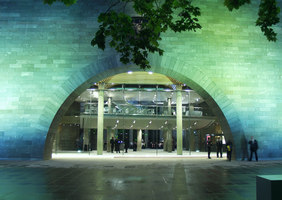
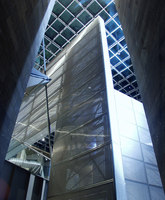
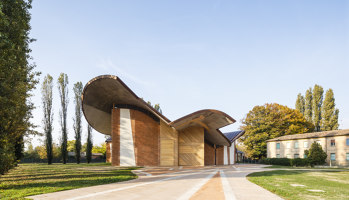
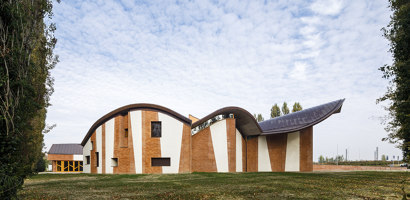
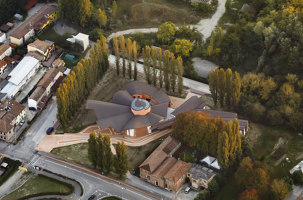
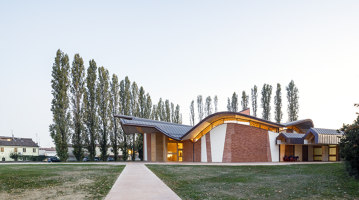
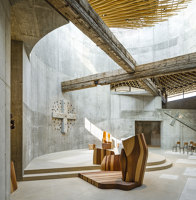
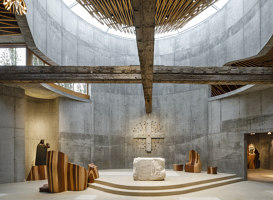
A beautiful example of modern earthen architecture is the Oaxaca School of Plastic Arts in Mexico, designed by Taller de Arquitectura- Mauricio Rocha.
The archiect decided to use the earth left behind from several other campus construction projects for the typography of his construction site – a talus which is a garden and isolation for the school at the same time. This brought about the idea of building the whole school of rammed earth. The earth for the buildings was extracted from areas around Oaxaca with the quality needed for this type of construction. Rammed earth is not only the perfect material for the extreme climatic conditions of Oaxaca, because it creates an optimal microclimate. It also offers the adequate acoustic insulation a school needs.
This year´s winners of the Boston Society of Architects in the category Sustainability Citation have been Signer Harris Architects with their ‘West Basin House’ in New Mexico, a 7000 sf-extension of a traditional New Mexican residence building.
Independent from the electric utility grid
The goals of the architects were to create a home truly reflective of the site and the local culture and implement the principles of sustainable design and material selections – including the use of solar electrich panels for generating power and leaving the home completely off the electric utility grid. Understandable that it was a challenge to adress the desire of the client to have an “antique home of traditional architecture” on the one hand avoiding cliché on the other hand.
7000sf extension of an existing traditional residence building
Here the design response:
We created a traditional courtyard plan where each component – living room/kitchen, bedrooms, and master bedroom – is connected only by exterior portals (vernacular term for “covered porches”). The courtyard elements should frame views of the ranch lands and mountains. We tried to vary the design of each component in an evolving architectural style – from the traditional living/dining/kitchen building at the core of the home, to what appear to be more recently constructed bedroom and master suite buildings around the courtyard. The design variations suggest a narrative and an evolution of the home, providing a sense of history and the character that comes with age. We took advantage of sustainable materials, such as autoclaved aerated concrete blocks, that inherently support natural responses to environmental conditions. In adition to that we incorporated a full array of photovoltaic panels, solar heating panels, batteries, and other technologies to allow for modern living in this energy independent home.
Earth – many of us see it as a rather primitive building material used for rural housing of third worlds areas. In fact mud brick and rammed or compressed earth, some of the world´s oldest and most applied building materials, are increasingly becoming the focus of modern architecture – not only for their ecological benefits but also for their efficient building insulation and climate control.
Earth as the main building material
A representative example is the Redding Residence by the US architects of the Kendle Design Cooperative. Using the soil from the site as a primary building material the luxurious residence is discreetly integrated into its direct sourroundings.
Redding Residence by Kendle Design Cooperative
What the architects say:
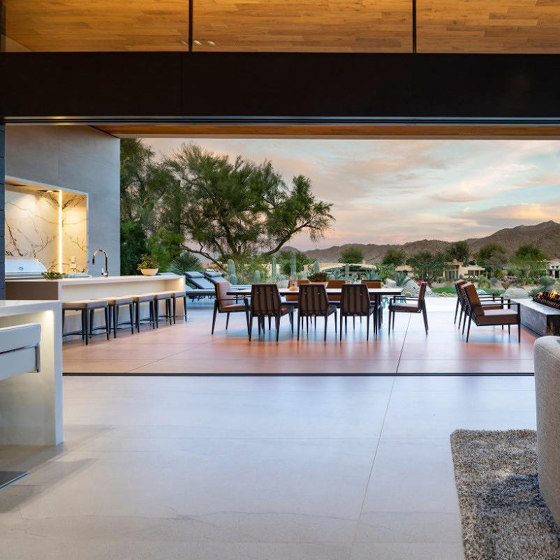
“Sustainable building techniques are used extensively throughout the design of this home. These include extensive overhangs that protect both interior and exterior living spaces from the desert sun, rammed earth construction and low-E glazing to mitigate heat gain through the exterior walls, indirect daylighting to avoid glare and minimize need for electric lighting, 19 seer air conditioning units with zoned distribution, smart house technologies controlling lighting, mechanical and powered shading devices, building materials made from recycled content and xeriscape design. These along with a host of additional “Green” building techniques qualified this home for the Advanced Level Category of the Scottsdale Green Building rating system.”
The Finnish textile company Hann Korvala Design was founded in 1994, when the young textile designer Hanna Korvela realised her first ‘Duetto’ rug. Since then, she received several international awards and works in close cooperation with architects and interior designers and realises comprehensive, tailor-made interior design and art works for both private homes and public premises.
Recently Hanna presented new editions of her classics ‘Duetto’ and ‘Encore’.
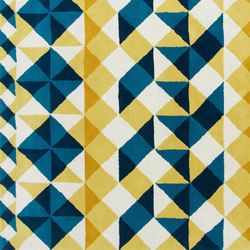
'Duetto 2' by Hanna Korvela
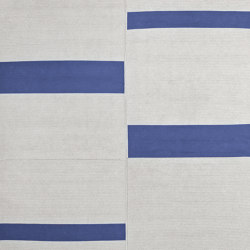
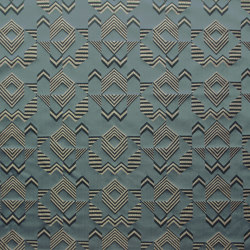
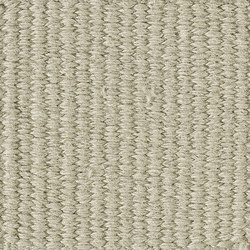
Duetto’s base is the geometrical rhythmic of two natural materials, paper yarn and cotton. In ‘Duetto 2′ the natural tone of the paper yarn has been replaced by pure white.
‘Duetto 2′ as well as ‘Encore 2′ is dust-free, durable and recyclable. As a cooperation product of Finnish Allergy and Asthma association, both carpets are perfect choices for allergic homes.
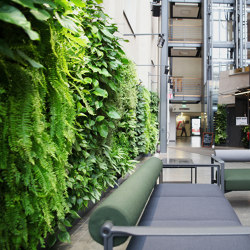
Balconies covered in plants decorate the Seventies' Tour Montparnasse: Jean Nouvel, Jean-Marie Duthilleul and Michel Cantal-Dupart, based on a sketch by Frank Gehry
“We have to think big”, said President Sarkozy on 30 April 2009 at the opening of the exhibition at the Palais de Chaillot, where ten of thirty-seven future models for the re-design of Paris are on display.
Paris is divided by an urban motorway which was built around the centre in 1973. This ‘boulevard périphérique’ diverts the traffic around and into the city and it regularly grinds to a halt, in spite of having up to eight lanes in each direction. Today it is one of Europe’s busiest roads.
Sustainable architecture: design by Atelier Castro Denissof Casi
Necessity is now going to be turned into sustainable development. Accordingly at the opening of the ‘Cité de l’architecture et du patrimoine’ at the Palais de Chaillot in the autumn of 2007 the French president called for a “diagnosis of the urban landscape and visions for the coming twenty to forty years”, inviting forty-three working groups of architects and town planners to submit ideas for a competition. The results are to be seen in this exhibition.
The Swiss designer Olivier Sottas presented at this year´s DMY Festival in Berlin ‘Plié’, a series of floor lamps. The lamps are composed of a paper lampshade, which gets its structure and stability from the artful folding, and a base made of thin plywood pieces. Unassembled it can be sent flat-packed. For its lightness and its biodegradable materials ‘Plié’ is impressive in terms of sustainability.
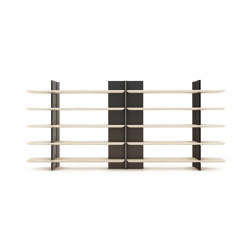
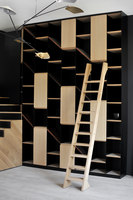
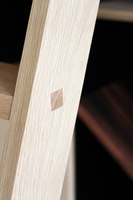
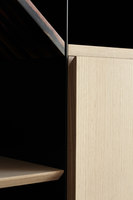
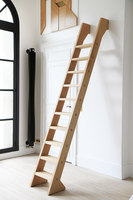
The Spanish manufacturer recently presented a new, rather sustainable shelving system designed by the German designers Max and Hannes Gumpp and the Spanish designer Toni Pallejà. The modular system is composed of 6 ABR Latten chairs, which were already designed by the brothers, and 4 vertical colour (colour combination to be decide by the client), white or black lacquered pine sticks and 2 horizontal white lacquered pine sticks. All this assembly by transparent plastics zip tips
We all remember the charming little blow up chair ‘Plopp’, which uses a production process invented by the Faculty of Computer-Aided Architectural Design (CAAD) at the ETH Zurich under Dr. Ludger Hovestadt. Last week, Oskar Zieta, designer of ‘Plopp’ and collaborater at the ETH Zürich, presented together with ETH students a new rather advanced design of a Vertical Axis Wind Turbine (VAWT), which was developed using the same ‘FIDU’ technology. These small but efficient turbines are designed for individual use. “We calculated that two turbines can supply an avarage 4 persons family household”, Zieta mentioned. The low weight, minimal material consumption and the low cost of production are a big step in the development of the generation of renewable energy.
VAWT for individual use
MAS students: Mathias Bernhard, Katerina Bouziana, Kent Brockmann, Günes Direk, Aphrodite Stavropoulou, Jasmin Zarali
The Independent Source for Products, Materials and Concepts
Creative materials consultants to the architecture and creative industries.
Fascinating World of Design for Modern Kids
Broadcasting Architecture Worldwide
International Architecture News
Online Design Magazine