Posts tagged as 'Spain'

The Azahar Group Headquarters, photo by Alejo Bagué
The Barcelona based architectural practice OAB realised the new headquater for Azahar Group, a company whose service is strongly linked to sustainability and environmental issues. The new headquarter should reflect this commitment.

The Azahar Group Headquarters, photo by Alejo Bagué
“With this as a framework, and with the availability of a 5.6-hectare piece of land next to the N-340 highway, part way between Castellón and Benicàssim, the project contemplates three interventions: the covered greenhouses and exterior nursery plantations; a building for services complementary to the activities developed by the company; and the group’s corporate headquarters.
The headquarters is erected as an icon building maintaining a close relationship with the landscape. To both the north and west the topography of the mountains serves as a backdrop to the building, against which the geometrical roofs repeatedly stand out. From a distance their facetted shape and outline help situate the building in the landscape.”

The Azahar Group Headquarters, photo by Alejo Bagué
“Orientated on the east-west axis, the headquarters building is structured as two wings united by a central body around two open patios of a very different sort. The first as a “parade ground” or external reception area for users and visitors, and the rear one, landscaped and for more private use.
In this way it is closed off to the distant landscape and its own climate and interior/exterior rapport established.
These patios provide a cross view between the glazed frontages, and no direct radiation exists towards the interior inhabitable spaces..
The four wings that accommodate the company’s different departments converge in a main hall which, as well as acting as a distributor, is a large exhibition space. The lighting of this hall is overhead, so that the special north light is introduced inside the building through a huge skylight extending over a sequence of girders.”

The Azahar Group Headquarters, photo by Alejo Bagué

The Azahar Group Headquarters, photo by Alejo Bagué
more information about the project @ Architonic
to the OAB profile @ Architonic
Palacio de Congresos, Badajoz, by SelgasCano, photo by Roland Halbe
The Madrid based practice SelgasCano realised this cylindric conference center in Badajoz / Spain. The building was awarded by the Museum of Modern Art in New York and is regarded as one of the most important 50 Spanish constructions of the last 30 years.
Palacio de Congresos, Badajoz, by SelgasCano, photo by Roland Halbe
Here is what the architects say:
“The base on which we work is rather unrepeatable, strange: the old bullring of the city, circular, inserted in a pentagonal bastion of the Vauban XVII century wall. In the contest final report we have always excused ourselves for using a quote from Leopardi as our headword: “The last stage of knowledge is recognizing that all we were looking for was always in front of our eyes”. With this quote we summarized the process of how the initial difficulty involved in acting in such a conditioned place became resolved when we realized that what we were looking for already existed.
The bullring was created for the city of Badajoz in the specific enclave of the Baluard of San Roque over the remains of the old bullrings that have existed there throughout the centuries. We consider of great importance the palimpsestic process of all the previous bullrings and their evolutions, not only the last one we encounter in that site. We are not concerned with the physical echo of what is no longer there, but rather with the condition created previously, in the XVIII century, by the decision of emptying a circle in a massive pentagonal bastion, distorting the whole defensive concept and turning it around to make it receptive to public access and public events, either a bullfight, a concert or a conference. Therefore our decision from the beginning was to maintain this condition of a public empty space, of a space taken from the city. In order to maintain it, we “limited” ourselves to covering the whole existing field, filling it in completely. The difficulty in applying this procedure to fill a plot of land is due to the fact that it is a circular void on a bastion and so it must remain.”

Palacio de Congresos, Badajoz, by SelgasCano, photo by Roland Halbe
“The complexity of placing a Conference Centre in an empty space and maintaining it empty is resolved by means of a simple trick, a magic trick, consisting of inverting the spectator area and taking it to the ring, to the centre, and taking the empty central area to the spectators, to where the old stands used to be. Then we dress the cylinder that is produced in the centre with light, projected upon the outer polyester rings that mark the uncertain limits of a void. Of course, the trick is prepared by placing underground and under the bastion the greatest possible number of elements of the program, placed in a radial position projecting towards the centre.
From the outside we might think that the shelter of the main entrance is the only existing construction or crank that appears, represents and opens, down the staircase it covers, the whole building.
From the inside, the main room corresponds to the same exterior idea of the cyclinder with luminous walls of the same acrylic material, translucid ceiling in the shape of a grid on which the shadow of the óculo moves, and a floor of the same dark colour as the plaza and the external patio. From the outside, this work, almost finished, has been creating, overall, a great unrest: the more we work on it, instead of appearing, it disappears. Diluted in that inevitable heritage.”

Palacio de Congresos, Badajoz, by SelgasCano, photo by Roland Halbe
more architecture and design projects @ Architonic
'Dunes' by Outofstock
The international design collective Outofstock, Gabriel Tan and Wendy Chua from Singapore, Gustavo Maggio from Argentina and Sebastián Alberdi from Spain, originally met in Stockholm during the Electrolux Design Lab in 2005. After a renunion in 2006 they decided to work together. Today Outofstock is based in Singapore, Barcelona and Buenes Aires.

'Dunes' by Outofstock
“Dunes is a set of modular, stackable screens inspired by the undulating sand dunes of the desert. We used thick elastic chords to weave surfaces within an inverse-triangulated steel frame. The result is a screen with rich colour gradients that act as a low-opacity colour filter, defining a semi-private space. They can be combined to form a continuous linear partition or used separately as spatial markers.”

'Saturn' by Outofstock
“Saturn is a pendant lamp made of welded pentagonal shapes in aluminum alloy. Its clean geometric form contrasts with an undulating vortex of elastic threads under the lamp shade – a clash of order and disorder. The stitch-detail along the edges of the lamp lends a touch of hand-craftedness to the final product.”
Lacquered steel and elastic chords.

'Saturn' by Outofstock
to the Outofstock website
Municipal Congress and Exhibition Center by Fancisco Mangado, photo by Miguel de Guzmán
The Spanish architect Francisco Mangado recently unveiled the new Congress and Exhibition Center in Ávila in central Spain. The center is situated outside the well-preserved romanic city wall, which sourrounds the historic city completely.

Municipal Congress and Exhibition Center by Francisco Mangado, photo by Miguel de Guzmán
Here is what the architects say:
“Ávila is a dense and intense city. Surrounded by walls which have served to delimit and control its growth, every corner, every building and every framed view that derives from the sinuous tracing of its streets comes to highlight this perception. However, there is another density, a more intuitive one, which has to do with the quality of the land itself: a topographical, mineral compactness whose presence is revealed in a superb landscape sprinkled by granite stones which struggle to emerge and finally manage to do so in the artificial form of city walls. Ávila itself is a rock amid the harsh landscape surrounding it.
Within such thickset contexts, any clear space takes on an added value much related to the concept of contrast or of boundary. In such cases a square serves as a means to free up interior space, and externally, to articulate the relationship with the city walls. The area outside the walls, usually linked to commercial activity, belies the origin of these voids which organize the space between the city inside, and the city outside. These areas which have managed to remain clear have earned the power to structure the city in the course of the years. The presence of an open space at the foot of the walls – once a river bed and later a cattle market –, where the new Congress Center shall go up, allows to think of new systems to structure the urban space.”

Municipal Congress and Exhibition Center by Franciso Mangado, photo by Miguel de Guzmán
“The site is characterized by the deep slope and the subsoil, which at least in the designated construction area, is granitic, thereby making excavation difficult. During project design the guiding principles were conceptual density, generosity in the way of occupying space, and exploitation of the topographical features of the site. The landscape, studded with granite pieces, provided the references needed.
The Municipal Congress and Exhibition Center is aimed at becoming a meeting place to celebrate different kinds of events, a leveled area or plaza at the edge of the walls. The main level of this area is matched up with the highest point of the plot, so that its extension generates a large interior void that shall house, without excavation, the required functions. This ensures that the new constructions, in spite of the scale of the programs they serve, do not stand out disproportionately. As it nears the river, this leveled area adjusts with polyhedric folds to the lowest parts of the plot. However, the grounds where the building rests remain as a raised platform which allows to establish a visual relationship with the opposite bank and the river itself.”

Municipal Congress and Exhibition Center by Franciso Mangado, photo by Miguel de Guzmán
”In accordance with the contours of the site, the project combines two different geometries: the most orthogonal and elongated space contains the auditoriums and main halls, while the most precipitous and uneven one contains the exhibition spaces. Entry to the complex is clear and easy: the main auditoriums are reached from the square and from the higher part of the seating area, which allows to get a quick grasp of the interior space; and the exhibition areas have an independent entrance from the incisions on the platform in the eastern boundary and, since all the different areas are connected under the square, they can also be reached from inside the building. The exhibition halls of these levels are set out as extensions of the foyer areas. All public accesses concentrate at the square, whereas the service areas are located in the northern end, where the slope of the terrain has been maintained.”

Municipal Congress and Exhibition Center by Franciso Mangado, photo by Miguel de Guzmán
“From a formal and constructional point of view, the project draws inspiration from the evocative strength of the landscape, from the granitic mass which pervades everything. Seen from afar, and high up on the walls, the building should reveal no planes, but rather leave a volumetric imprint, as a sculpture carved out of the terrain. For this reason the roofs shall be designed to smoothly extend the vertical surfaces. The elongated, more orthogonal building is precisely sculpted; and the more abrupt piece which covers the exhibition areas is built by tilting the base of the square, and then spreads to meet the surrounding landscape. These folds generate the incisions through which natural light floods the interior, also allowing independent access to this area. Instead of thin cladding, thick granite pieces shall be used.
In keeping with the exterior treatment of the pieces, the interior halls will be clad in laminated glass with a fiberglass infill, generating a dense and mineral – rather than transparent – appearance.”

Municipal Congress and Exhibition Center by Franciso Mangado, photo by Miguel de Guzmán
Direction: Francisco José Mangado Beloqui
Team: Jose M. Gastaldo, Francesca Fiorelli, Daniel Padrón Hernández, Daniel Marchelli, Ana Gabriela Salvador, Arina Keysers, Antje Konrad.
Installations engineering: Grupo JG Asociados (Enrique Monreal / Víctor González) Ingenieros
Acoustic engineering: Higini Arau Estudi Acustic
Lighting: ALS Lighting arquitectos consultores de iluminación (Antón Amann)
Quantity surveyors: Angel García. PA Aparejadores (Luis Pahissa / Fernando Pahissa)
Contractor: Volconsa SA
to the Franciso Mangado website
'Torres de Hercules' by Rafael de la Hoz Architects
Recently the Spanish Rafael de la Hoz Architects completed the ‘Torres de Hercules’ in Cadiz. The towers symbolise the legendary Pillars of Hercules and are the tallest buildings in Andalusia.
Two cylindrical, white towers rising from a flat pool of water. On the façade-a giant lattice-appears the mythical motto from the legend of the Pillars of Hercules, “Non Plus Ultra” (nothing further beyond), warning sailors in the Mediterranean of the edge of the known world.

'Torres de Hercules' by Rafael de la Hoz
“At a height of 126 meters, the “Torres de Hercules” rise up from the Bay of Algeciras, as a new benchmark in the Campo de Gibraltar and the transition of the Straight, as their uniqueness changes the area’s landscape.
Located in the Bay of Algeciras (Cadiz) , the new construction, which is surrounded by a man-made lake, is comprised of two identical 20-storey cylindrical towers, joined by a crystalline prism which houses the hallways connecting the two buildings.”

'Torres de Hercules' by Rafael de la Hoz Architects
“Its outer appearance is configured by the structure of the building, a gigantic lattice which completely surrounds the perimeter. They contain the giant letters of the legend “Non Plus Ultra”.
Their job is to protect the inside of the building from excess solar radiation while providing panoramic views of the Bay of Algeciras, the Rock of Gibraltar, and the Serrania.
This grid extends past the building’s limits, as a “unique element” protecting the terrace roof-top deck, while at the same time acting as a base for possible energy collecting and telecommunications systems.
The project, with a total surface area of 19,000 square meters, was contracted by the Valcruz company of Cordoba. They will use the majority of the building for office space, although some of the floors will have commercial space and services, such as: coffee shops, bank branches, a travel agency, a messenger service, etc.”

'Torres de Hercules' by Rafael de la Hoz Architects
“On the top floor, 80 meters up, will be a lookout restaurant. Above this, a panoramic roof-top deck will boast unique views over the Straight of Gibraltar, Mount Musa and the Alcornocales Natural Park.
The building has a main entrance for pedestrians and cars which provides a clear view of the towers. The 200-spot ground-level parking lot is located on the other side of the towers and is organized around a landscaped area.
The complex has a strategic location, which utilizes all of the region’s potential while at the same time being easily accessible. The objective is to take advantage of all of the possibilities offered by the Bay of Algeciras and the accessibility by the major motorways from Seville, Gibraltar, the Costa del Sol, and the Jerez de la Frontera airport.”

'Torres de Hercules' by Rafael de la Hoz Architects

'Torres de Hercules' by Rafael de la Hoz Architects
Area: 19.600 sq m (204,514sq ft)
Use: Office
Height: 100 m (328ft)
Stories: 20
Owner / Developer: Valcruz
Collaborating Architects (Rafael de La-Hoz Arquitectos Studio): Jesús Román, Peter Germann, Markus Lassan, Alex Cafcalas, Ulrik Weinert, Iván Ucrós, Ángel Rolán, Margarita Sánchez, Nicolas André, Ivonne de Souza y Paola Merani.
Contractor: Construcciones Sánchez Domínguez-Sando
to the Rafael de la Hoz Architects website
'Dr. Bubbles goes on the Rocks' by Studio Harry&Camilla
The Barcelona based Studio Harry&Camilla designed this sculptural metal chair which was presented at this year’s TDF, Tenerife Design Festival. ’Dr. Bubbles goes on the Rocks’ was exhibitied at the Tenerife Espacio de las Artes, a beautiful multifunctional art centre designed by Herzog&de Meuron.

'Dr. Bubbles goes on the Rocks' by tudio Harry&Camilla

Detail

Tenerife Espacio de las Artes designed by Herzog&De Meuron
to the Studio Harry&Camilla website
to the Tenerife Design Festival website
photo by Juan de la Cruz Megías
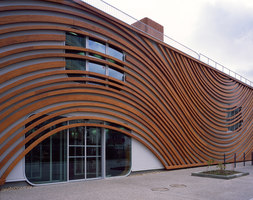
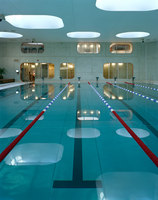
The Spanish architects of SUBARQITECTURA realised these laboratories for the UMH University in Orihuela / Spain together with their collegue J.M. Torres Nadal. The building is located inside the Campus de los Desamparados in Orihuela, next to a lemon orchard. There, the conditions of light, lack of rain and heat are extreme, exceeding 40º C during the summer months.

photo by Juan de la Cruz Megías
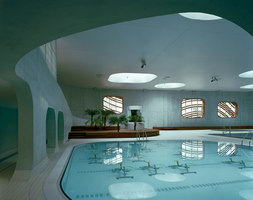
“Laboratories and departments are grouped by a structure of interspersed rings, which contain a system of semi-outdoor courtyards connected with each other at different levels.
These rings are composed of three white plastic strips: the bottom one, in contact with the ground, is semi-transparent and porous, and lets you view the outside when you are sitting; the middle strip, very opaque and technical, leads the large volume of required facilities inside; and the last one, very diffuse, regulates the atmosphere and creates shadows, as a big cloud.”

photo by Juan de la Cruz Megías
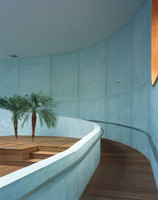
“The semi-open courtyards become important meeting spaces, while allowing access to labs. In its technified semi-interior, conditions of light, humidity and temperature are locally modified by multiple infra-red and humidifiers.”

photo by Juan de la Cruz Megías

photo by Juan de la Cruz Megías
Client: UMH (Universidad Miguel Hernández)
Built Area: 1954 m2
Completed in June 2008
to the SUBARQUITECTURA website
to the J.M.Torres Nadal website
'Interlock' by Tomek Rygalik for ABR
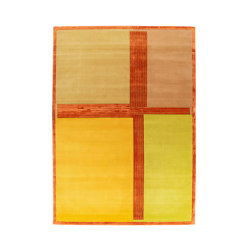
The Polish designer Tomek Rygalik created this modular carpet made from woven wool for the Spanish 2005-founded label ABR.
A single piece acts as a base in this model of carpet. The framework of the laterals represents a jigsaw puzzle. New pieces could be added longitudinally. Each piece is made of three different layers. Each layer has its own colour. That allows at least the use of two different colours with the outer layers.

'Interlock' by Tomek Rygalik for ABR
The material of the carpet is completely new. Pure wool woven in a way it look alike felt. It is not conglomerated -as in felt. It has been woven with looms following a traditional Polish technique.

'Interlock' by Tomek Rygalik for ABR
more ABR products @ Architonic
more Tomek Rygalik products @ Architonic
more carpets @ Architonic
‘LSS Latten Shelving System’ by ABR
Q-House by asensio_mah, photo by Ricardo Loureiro
In May this year the Spanish architects asensio_mah unveiled this single family residence in the North of Spain. The façade consists of customized dark “composite” panels which have different surface consistencies and textures.

Q-House by asensio_mah, photo by Ricardo Loureiro
But let the architects explain it better:
“The house is a conscious exercise in developing an alternative domestic environment to the surrounding villas of the new suburban neighborhood. The solutions for the development so far have typically been compact villas located on abruptly leveled gardens, irrespective of the complex topographical condition of their sites. Our ambition for producing an alternative domestic atmosphere is developed by constructing a more explicit relationship between the house and garden with the existing conditions of the steep site. This organizational strategy for the house sought to register the difference in topography within the parcel by organizing a series of terraces that configure the framework for a landscape with differentiated characters.”

Q-House by asensio_mah, photo by Ricardo Loureiro
“This deliberate geometric configuration affords multiple readings of the outline of the house while facilitating a rich experiential lifestyle within its volume and landscape. Specific organizational and material strategies were developed to produce different volumetric and perceptual readings that change with the different vantage points towards and within the house.”

Q-House by asensio_mah, photo by Ricardo Loureiro
“The building is organized in three bands that are arranged around a central circulation core. These three bands maintain a prevailing orientation in the northeast-southwest direction to secure maximum daylight in every room. While the bands configure and organize the different rooms, the circulation core underpins a switchback pattern of shifting orientations with the gradual vertical movement through the house.”

Q-House by asensio_mah, photo by Ricardo Loureiro
“The house is clad in dark “composite” panels that have been customized with digital fabrication techniques. These customized panels are used to articulate sections of the house volume in order to introduce legibility to the overall form. These panels offer a range of different surface consistencies and patterns to the house that reflect the sites changing light conditions in multiple ways, producing an ever changing range of texture and tones.”

Q-House by asensio_mah, photo by Ricardo Loureiro
Location: North of Spain
Completion date: May 2009
Detail design: in collaboration with J.M. Aguirre Aldaz
Site supervision: in collaboration with Satie Arquitectos S.L.
Structure: Egitur S.L
Photography: Ricardo Loureiro
Team credits: Diego Repiso, Jennifer Chuong, Kaizen Chen, Jon Aguirre.
to the asensio_mah website
to the Ricardo Loureiro website
'Dayboard' by StokkeAustad
First presented at last year’s Stockholm fair the playful calender designed by StokkeAustad is now in production, thanks to the Spanish manufacturer ABR.
The starting point for this design is idea that the way in which year goes by is characterised by highly personal and subjective events. The Norwegian designers broke up the strict chronological order, that calenders usually has in order to enable the user to shape his own timing of the year.

'Dayboard' by StokkeAustad
“We wanted to design a calendar which would allow people to arrange their days more freely – does a year always move in a straight line? Does your summer feel more dominant than your winter, or the other way round?” the designers say.
The calendar is put together from 365 coloured, magnetic metal plates, each of which contains a date. The winter days are coloured a cool blue, but then in spring change to green before shining an intense yellow in the summer, until in autumn they change to a warm orange, then red, and then an intense violet.

'Dayboard' by StokkeAustad
more ABR products @ Architonic