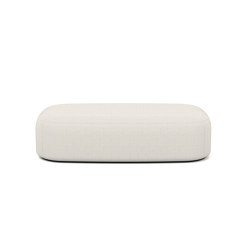
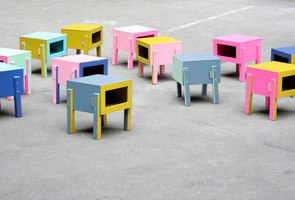
The German manufacturer e15 developed this conceptual stool together with the producer of high quality paper Arctic Paper. Composed of a 60mm solid wooden base and 2200 pages of 120gr Munken paper the ‘Munken Cube’ forms an intelligent working tool – a giant sketch-book. Due to the onesided glueing of the paper the block is twistable and flexible in form.
The Berlin based designers Formfjord produced relief for a problem we all know: The naked light bulb in the freshly furnished apartment creating this unpleasant, cold light until you finally find the right lamp to replace it with. ‘New Flat’ turns the stopgap into a charming lamp. The cardboard lampshade can be sent by post in a A4 envelope as a greeting card.
The Canadian manufacturer molo is specialised in flexible honeycomb structures made from paper and textiles of which they create room deviders, furniture and interior lighting. ‘Cloud Softlight’ is the newest product of the Vancouver based company. It is available in four different sizes and can create a luminous overhead canopy, hung in clusters, tailored to the individual space they are shaping. Light source: LED
The Dutch designer and member of the Temporary Collective Arnhem Debbie Wijskamp realised this edition of rather solid looking cabinets made from handmade paperpulp.
'Paperpulp' cabinets by Debbie Wijskamp
“Inspired by different cultures, making their homes with materials found in their surroundings, Wijskamp wanted to design her own building material. Experimenting with the re-usage of wastepaper resulted in a material with its own characteristic appearance and structure. Besides this, it is a very versatile material with many possible applications.”
'Paperpulp' cabinets by Debbie Wijskamp
The Temporary Collective Arnhem will also be exhibiting at the DMY festival in Berlin from 9-13 June 2010.
Eric Testroete worked as a 3d, mainly character artist in the Vancouver game industry for 9 years. In the last three years he focused on world art.
Obviously it was his former job that inspired him for this three dimensional self portrait which he dedicated this year’s Halloween.
'Self Portrait' by Eric Testroete
“The head was modeled in 3ds Max based off of photos I had Jen take. The final triangle count was 370
'Self Portrait' by Eric Testroete
“The texture was done with Mudbox 2010 and Photoshop CS3. The projection features work great to get a texture down quickly. After that I used the new export screen to PSD feature to clean up the texture and remove shadows.”
These are the two new wallpapers by the Swedish designer Camilla Diedrich. As one of the first textile designers to start cutting holes in textiles and structuring them in terms of negative space, Diedrich’s early works related more to deconstruction architecture than they did to fabric design.
With ‘Westwood’ – a wallpaper for corners – she once more underlines her architectural approach.
'Westwood' – a wallpaper for corners by Camilla Diedrich
‘True Blue Gold’ is printed like in the old days, nearly handprinted on a more than 100 year old machine in Sweden with the highest quality real artist pigments
that is glimmering, this make the surface very living, far from the ordinary machineprinted wallpapers made today.
It is all organic, ecological produced and totally resistant against sunlight, will never fade/bleach.
It is a ultramarine blue or white bottom with splashed vivid lines in glittery gold. 1 Roll is 10 meters long x 54 centimeter width, repeatable in all direction.
Also at the Northumbria University’s exhibition the graduate Philipe Luscombe presented this delicate relief calender, which is entirely embossed using brass die parts and a hand press.
2010 Calender by Philip Luscombe
The design of the die allows the days and months to be shuffled to any eventuality, so the brass parts can be used to press any day of any month until the end of time. The calendar includes all British bank holidays and marks special occasions with pictographic squares.
With the 'Cabbage Chair' the designer takes advantage of the Pleats Please Issey Miyake manufacturing process
During this year’s Copenhagen Design Week from 27 August to 6 Septmeber the exhibition ‘SHOWHOW’ will showcase solutions which demonstrate that it is possible to produce design solutions that create positive social, environmental and economic change while continuing to delight the senses.
“A number of themes will be explored such as architecture, transportation and energy, thus displaying products and services that will come to play an important role in our lives. In this way the COPENHAGEN SHOWHOW will present a positive message and demonstrate that engaging with social and environmental issues is a creative and life-changing experience for us all. Both Danish and international design solutions will be presented.”
Unfolding the 'Cabbage Chair'
One of the showcased products will be the ‘Cabbage Chair’ by Nendo / Oki Sato. It consists of the waste paper byproduct from the ‘Pleats Please Issey Miyake’ manufacturing process. ‘Pleats Please’ is a technique in which the garments are cut and sewn first, then sandwiched between layers of paper and fed into a heat press, where they are pleated.
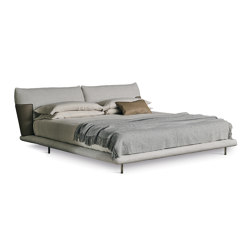
The 'Cabbage Chair' unfolded
Talent Show:
SHOWHOW presents also 10 projects of young designers that caught the attention of the international jury at a special ”Talent Show” exhibition and recognize their fresh thinking with a prize giving ceremony. The jury consists of Ross Lovegrove, Bjarke Ingels, Jens artin Skibsted and Henrik Hovgaard.
The Independent Source for Products, Materials and Concepts
Creative materials consultants to the architecture and creative industries.
Fascinating World of Design for Modern Kids
Broadcasting Architecture Worldwide
International Architecture News
Online Design Magazine