Posts tagged as 'offices'

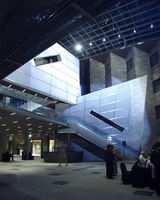
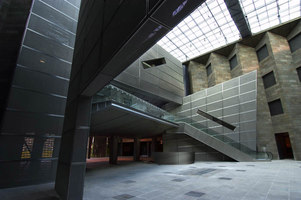
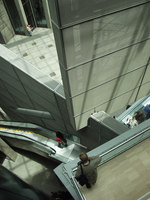
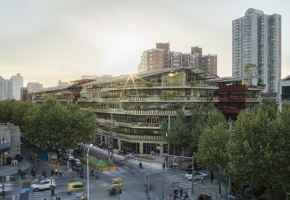
KANTOOR INFRAX WEST by Crepain Binst Architecture

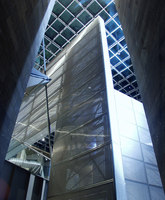
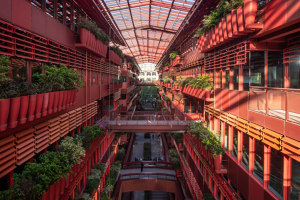
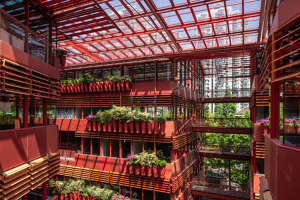
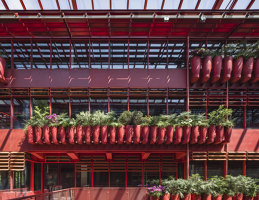
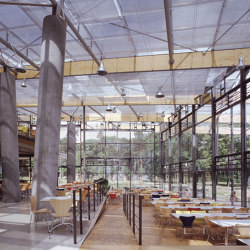
The Antwerpen based practice Crepain Binst Architecture recently unveiled this new office building for the Belgian utilities service provider Infrax. Due to diverse eco-innovative techniques such as a technical front wall with integrated photovoltaic panels, a borehole energy storage field (BEO field) and core concrete activation (BKA) the architects yielded primary energy savings of 42%, a saving of ca. €30,000 each year.

KANTOOR INFRAX WEST by Crepain Binst Architecture

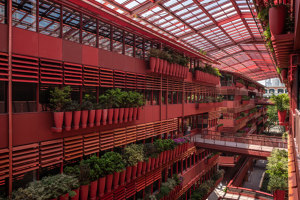
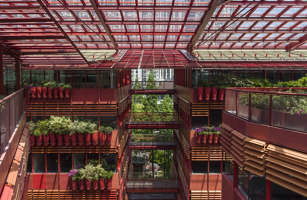
“The central pillar of the design is the creation of an innovative wall that is both literally and metaphorically green. It is construction in different ‘skins’, allowing it to regulate light, air and sound for the building.
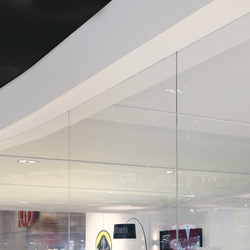
The outer skin consists of screen printed glass panels in 3 colours and three degrees of transparency. The mosaic formed by all these elements and the wall’s ingenious construction have made an unmistakable contribution to the building’s expressive and dynamic character. This technical ingenuity has been combined with unbroken space in the offices: A large free height of 3.40 m and a column-free span of 16 m have made the space airy and extremely flexible. The décor was deliberately kept restrained, using white as the main colour and warm shades of grey for the flooring and acoustic screens. A few carefully chosen black accents emphasise secondary functions and vertical circulation in the building.”

KANTOOR INFRAX WEST by Crepain Binst Architecture

“The closed character of the upper building is in contrast to the transparency and openness on the ground floors where the semi-public functions and lunchroom are located.
The large areas of glass give visitors and passers-by a look behind the screens at everyday business in and around Infrax.

We also designed a new logistics centre consisting of a functional warehouse with connected outdoor storage located beside the office. This warehouse is more than a mere depot: it is an extension of the office’s architectural qualities which does not compromise sustainability and flexibility.”

KANTOOR INFRAX WEST by Crepain Binst Architecture

KANTOOR INFRAX WEST by Crepain Binst Architecture

KANTOOR INFRAX WEST by Crepain Binst Architecture

more information about the project @ Architonic


to the Crepain Binst Architecture profile @ Architonic

Tue 23.3.

Hegau-Tower by Murphy / Jahn (USA)
Posted by Nora Schmidt on 23.03.2010 - Tagged as: , , ,

Hegau Tower by Murphy / Jahn, photo by Rainer Viertlböck

The Chicago based architectural practice Murphy / Jahn, renowned for their tower constructions such as the ‘Bahn-Tower’ at Berlin’s Potsdamer Platz or the ‘Messeturm’ in Frankurt, realised this 68 m high, 18 storeyed office building in Singen/Germany.
Hegau Tower by Murphy / Jahn, photo by Rainer Viertlböck
Hegau Tower by Murphy / Jahn, photo by Rainer Viertlböck

Hegau Tower by Murphy / Jahn, photo by Rainer Viertlböck

to the Murphy / Jahn profile @ Architonic

The Azahar Group Headquarters, photo by Alejo Bagué

The Barcelona based architectural practice OAB realised the new headquater for Azahar Group, a company whose service is strongly linked to sustainability and environmental issues. The new headquarter should reflect this commitment.

The Azahar Group Headquarters, photo by Alejo Bagué

“With this as a framework, and with the availability of a 5.6-hectare piece of land next to the N-340 highway, part way between Castellón and Benicàssim, the project contemplates three interventions: the covered greenhouses and exterior nursery plantations; a building for services complementary to the activities developed by the company; and the group’s corporate headquarters.

The headquarters is erected as an icon building maintaining a close relationship with the landscape. To both the north and west the topography of the mountains serves as a backdrop to the building, against which the geometrical roofs repeatedly stand out. From a distance their facetted shape and outline help situate the building in the landscape.”

The Azahar Group Headquarters, photo by Alejo Bagué

“Orientated on the east-west axis, the headquarters building is structured as two wings united by a central body around two open patios of a very different sort. The first as a “parade ground” or external reception area for users and visitors, and the rear one, landscaped and for more private use.
In this way it is closed off to the distant landscape and its own climate and interior/exterior rapport established.
These patios provide a cross view between the glazed frontages, and no direct radiation exists towards the interior inhabitable spaces..
The four wings that accommodate the company’s different departments converge in a main hall which, as well as acting as a distributor, is a large exhibition space. The lighting of this hall is overhead, so that the special north light is introduced inside the building through a huge skylight extending over a sequence of girders.”

The Azahar Group Headquarters, photo by Alejo Bagué

The Azahar Group Headquarters, photo by Alejo Bagué

more information about the project @ Architonic


to the OAB profile @ Architonic

'Monaco House', photo by Trevor Mein

'Monaco House', photo by Trevor Mein

The Australian architectural practice McBride Charles Ryan realised this sculptural office building in the pedestrian area at the East end of Melbourne’s CBD (Central Business District).

'Monaco House', photo by Trevor Mein

'Monaco House', photo by Trevor Mein

“Dominant in the lane is the historic Melbourne Club wall and the gigantic plane trees emanating from the Melbourne Club Garden which arch over the diminutive lane. The site with dimensions of 6.1 m in width and 17m in depth and a foot print of 102.5 sqm is a postage stamp.

Our brief was to provide a ground level entry and café, followed by two levels of office tailored for the Proprietors Investment and Philanthropic Organisation. The top level contains a small reception area primarily for official functions associated with the client’s role as Honorary Consular of Monaco.”

'Monaco House', photo by Trevor Mein

'Monaco House', photo by Trevor Mein

“The process of the Aggregation of the Melbourne’s allotments is now almost universally seen as a process which diminishes urban quality and diversity. There is now an earnest attempt, even in large block developments, to reintroduce fine grain urbanism that has been lost to the city. This project is rare; despite renewed respect of fine grain urbanism there are few willing to make the significant investment that this type of building entails.

This was this client’s first foray into what may be considered contemporary architecture. Despite this inexperience, our client had a love of the design of cars, boats (particularly early 20C) and finely crafted objects. He bemoaned the loss of shape in the contemporary world. It was in the area of shape, craft and material that the architect and client found our common ground.”

'Monaco House', photo by Trevor Mein

'Monaco House', photo by Trevor Mein

'Monaco House', photo by Trevor Mein

'Monaco House', photo by Trevor Mein

more information about the project @ Architonic

to the McBride Charles Ryan profile @ Architonic

Sales and financial centre voestalpine by Feichtinger Architects, photo by Josef Pausch

Sales and financial centre voestalpine by Dietmar Feichtinger Architectes, photo by Josef Pausch

The Paris and Vienna based Dietmar Feichtinger Architectes recently finnished the new sales and financial centre for voestalpine in Linz / Austria.

The curved cantilevered building is an addition to the existing ‘Blue Tower’ – together the two complementary structures form the entry to the plant of voestalpine, one of the leading steel combines.

Sales and financial centre voestalpine by Dietmar Feichtinger Architects, photo by Josef Pausch

Sales and financial centre voestalpine by Dietmar Feichtinger Architectes, photo by Josef Pausch

Here is what the architects explain:

The building is seen already from a far distance. The cantilever of several storeys covering the entrance area of the building is an inviting gesture. It symbolizes the ambition of a modern and innovative company. The open access area is a meeting place.


The new sales and financial centre

The gentle slope under the cantilever leads into a spacious lobby.

The ground floor is dedicated to services for all employees of the company – shops, travel agency, library, documentation. A walkway following the inner curve of the building forms a mall.

Access to the upstairs levels is restricted. Transversally the building is divided in 3 zones:

Individual offices are situated close to the facades. A central zone serves for meetings, provides space for team work including copy facilities and small coffee areas. Inner atriums are open over all storeys. They provide natural light for the inner zones and divide the building in sections.

Each atrium is closed by a glass roof. Roof integrated opening wings serve for natural ventilation of the office space (chimney effect). The atriums are planted.

Sales and financial centre voestalpine  by Dietmar Feichtinger Architects, photo by Josef Pausch

Sales and financial centre voestalpine by Dietmar Feichtinger Architectes, photo by Josef Pausch

The conference area on the roof
The conference area is situated in a very prominent position on the upper floor. It is directly accessible from the lobby by a dedicated lift. A group of meeting rooms can be combined in various configurations.

A large terrace, a wooden deck, offers a wide view over the industrial site.


Structure
The structure of the building is a combined steel and concrete structure.

Steel frames distanced by 10m50 carry a concrete slab. The columns are in the centre of the building, the side areas are carried by cantilever beams.

This configuration offers a large flexibility for office division.

The concrete slabs are kept visible. They provide the mass necessary for thermal comfort.

An integrated steel truss allows the free cantilever in the front of the building.

Sales and financial centre voestalpine by Dietmar Feichtinger Architects, photo by Josef Pausch

Sales and financial centre voestalpine by Dietmar Feichtinger Architectes, photo by Josef Pausch

The facade
The façade is largely transparent providing sufficient natural light for the 20m50 wide building. Opaque horizontally sliding openings allow natural ventilation.

Shading is assured by motorized steel elements made of a golden coloured steel mesh.

The entrance of the blue tower

Facing the new building the ground floor of the existing building is renewed. A large glass canopy covers the entrance area. Its steel structure is anchored in the structure of the existing building.

Sales and financial centre voestalpine by Dietmar Feichtinger Architects, photo by Josef Pausch

Sales and financial centre voestalpine by Dietmar Feichtinger Architectes, photo by Josef Pausch

Sales and financial centre voestalpine by Dietmar Feichtinger ArchitectJosef Pauschs, photo by

Sales and financial centre voestalpine by Dietmar Feichtinger Architectes, photo by Josef Pausch

Architect: Dietmar Feichtinger Architectes

Project team leader: Gerhard Pfeiler

Team: Philipp Hugo Urabl, Dorit Böhme, Roland Basista, Albert Moosbrugger, Ulli Gabriel, Andreas Trampe-Kieslich, Ralitsa Kafova, Camille Duperche, Katharina Düsing, Nemanja Kordic

Team Competition: Claire Bodénez, Benni Eder, Simone Breitkopf, Barbara Feichtinger-Felber, Vicentiu Sopterean, Silviu Aldea, Markus Himmel, Ruth Pofahl, Rupert Siller

Engineers: Schindelar ZT_GmbH

to the Dietmar Feichtinger Architects website

Detail View, Front Facade Steckelhörn, by J. MAYER H. Architects

Detail view, front façade Steckelhörn, by J. MAYER H. Architects, photo by David Franck

The Berlin based J. MAYER H. Architects recently unveiled their project “Steckelhörn 11”, an office building, located in the old centre of Hamburg, close to the prominent new “Hafen City” development. The sculptural architecture replaces a ruinous building and fills the gap between two historic premises. Due to the more or less triangular building area the extremly narrow back side façade is a promising contrast to the expressive front.

Backside View, Katharinenfleet, facade 1,9m, by J. MAYER H. Architects, photo by David Franck

Backside view, Katharinenfleet, façade 1,9m, by J. MAYER H. Architects, photo by David Franck

Here is what the architects say:

“…The vertical design and soft setbacks of the latter pay tribute to the massing of the surrounding structures, as well as to local building-height regulations. Cantilevered elements in the main facade create a series of specific spatial qualities on the inside and outside. The top floors provide additional outside space, offering a spectacular panoramic view over the city of Hamburg.”

Frontal: Main facade: Steckelhörn, by J. MAYER H. Architects, photo by David Franck

Frontal: Main façade: Steckelhörn, by J. MAYER H. Architects, photo by David Franck

“The particular geometry of the floor plan is the basis for the organization of the building, which architecturally and programmatically presents itself openly to Steckelhoern street while at the same time forming a characteristic landmark when perceived from the historic “Speicherstadt” and new “Hafen City”. As the ground level is conceived either as a spacious lobby for the main tenant or a public cafe, the upper floors provide for generous, flexible office space, most of it allowing a view of the “Katharinenkirche” and/or the “Hafen City”. The top floors provide additional outside space on balconies/loggias and a roof terrace, offering a spectacular panoramic view over the old and new city of Hamburg.”

Main Stairs, View down, photo by David Franck

Main stairs, view down, photo by David Franck

Inside: 7th Floor, Office Space, Stairs to Gallery, photo by David Franck

Inside: 7th floor, office space, stairs to gallery, photo by David Franck

Inside: Office Space, photo by David Franck

Inside: Office space, photo by David Franck

Backside View, Katharinenfleet, facade towards Hafencity, photo by David Franck

Backside view, Katharinenfleet, façade towards Hafencity, photo by David Franck

Project Team: Juergen Mayer H., Hans Schneider, Wilko Hoffmann, Marcus Blum

Project Date: 2007-2009

Completion: October 2009

Client: Cogiton Projekt Altstadt GmbH, Hamburg

Architect on Site: Imhotep, Donachie und Blomeyer with Dirk Reinisch, Berlin

Structural Engineers: WTM, Hamburg

Building Services: Energiehaus with Sineplan, Hamburg

Model: Werk5, Berlin

more architect’s profiles @ Architonic

to the J. MAYER H. website

to the David Franck website

SOF Park Inn Hotel Complex, Krakow / Poland by J. MAYER H.

Thu 8.10.

‘Frog Queen’ in Graz / Austria by SPLITTERWERK

Posted by Nora Schmidt on 08.10.2009 - Tagged as: , , ,

'Flog Queen' by SPLITTERWERK, phot by Paul Ott

Icons 'Frog Queen' by SPLITTERWERK, photo by Paul Ott

With ‘Frog Queen’ SPLITTERWERK once more demonstrates their preference for visually effective surfaces and spatial experiences created by large scale images, textures and patterns they apply on architecture.

The Graz-based design collective was commissioned to design this headquarters building for PRISMA Engineering, a machine and motor technology company also located in Graz. The objective was to design a structure which could house the company’s various research and development programs, and selectively showcase the work to a varied range of often competing clientele. Thus the building design needed to accommodate both highend testing and presentation without jeopardizing the security and secrecy with which the work is developed.

'Frog Queen' by SPLITTERWERK, photo by Paul Ott

'Frog Queen' by SPLITTERWERK, photo by Paul Ott

Here is what the architects explain:

“The building form approximates a cube, measuring 18.125 x 18.125 x 17m, wrapped on all four elevations with a pixilated pattern of square panels. From a distance, these panels appear to be painted in a range of ten values of grey tone, together dematerializing the volume of the building against both the trees of the surrounding site and the clouds and sky. Thus the cubic building is at once monumental in its objecthood in the open landscape – scale-less and immaterial – and yet utterly non-iconographic in its overall form.”

Lobby 'Frog Queen' by SPLITTERWERK, photo by Paul Ott

Lobby 'Frog Queen' by SPLITTERWERK, photo by Paul Ott

“As is characteristic of their work, SPLITTERWERK was interested in developing a play between pictorial image and spatial experience. Working with the effects of dimension, distance, and time, the building’s skin was designed to generate shifting perceptions of the volume and texture. As one approaches the building, the cubic proportions of the volume become apparent, as does the finer grain of surface articulation on each panel, comprised not of a single grey tone but rather a tight grid of abstract pictorial figures. These figures might be interpreted as flowers, speaking to the surrounding fields, or gear wheels, suggestive of the highly secretive work happening inside the building. Each façade panel is itself nearly square, measuring 67 x 71.5-cm, and made of powder-coated aluminum, screen-printed with the various images. Integrated within this field of figures, deployed at the scale of both panel and building, windows and doors are similarly considered such that they essentially disappear within the composition of the façade.”

Interior with photo wallpaper, photo by Nikolaos Zachariadis

Interior with photo wallpaper, photo by Nikolaos Zachariadis

“At the interior, individual office spaces are wallpapered with images of the surrounding Eastern Styrian landscape, creating a conceptual tension between the interior of the building envelope (narrative and pictorial) and the visual effects of its exterior panels (abstract and spatial). In this sense, the decorative strategy for both interior and exterior is conceived with certain landscape sensibilities in mind; a visual context which is simultaneously pictorial in its framed references and affective in the atmosphere it produces.” (Text by Ben Pell)

'Frog Queen' by SPLITTERWERK, photo by Nikolaos Zachariadis

'Frog Queen' by SPLITTERWERK, photo by Nikolaos Zachariadis

Location: Graz, Steiermark, Austria

Projectteam: Irene Berto, Mark Blaschitz, Erika Brunnermayer, Marius

Ellwanger, Hannes Freiszmuth, Johann Grabner, Edith Hemmrich, Ute Himmelberg, Bernhard

Kargl, Benjamin Nejedly, Josef Roschitz, Maik Rost, Ingrid Somitsch, Nikolaos Zachariadis

Client: PRISMA Engineering Maschinen- und Motorentechnik GmbH, Dipl.-Ing.

Ernst Gschweitl

User: PRISMA Engineering Maschinen- und Motorentechnik GmbH

Project management: Ingenos ZT GmbH

Structural consultant: werkraum zt-gmbh, Peter Bauer, David Lemp

Building services consultant: Ing. Rudolf Sonnek GmbH

HVACR design: Guenter Grabner

Energy consultant: Dr. Tomberger ZT GesmbH, Hannes Veitsberger

Electrical design: Erich Watzke, Moskon & Busz GmbH, Rudolf Busz

to the SPLITTERWERK website

Thu 28.5.

The Stone Towers by Zaha Hadid in Cairo

Posted by Nora Schmidt on 28.05.2009 - Tagged as: , ,

Stone Towers in Cairo by Zaha Hadid

Stone Towers in Cairo by Zaha Hadid

The London based Zaha Hadid Architects recently presented the plans for an office developement for the Rooya Group in Cairo.

The Stone Towers by Zaha Hadid Architects for Rooya Group of Egypt is located in the Stone Park district of Cairo. Providing office and retail facilities to a rapidly expanding Cairo, the unique 525,000sqm Stone Towers development also includes a five-star business hotel with serviced apartments, retail with food and beverage facilities and sunken landscaped gardens and plaza called the ‘Delta’.

Stone Tower by Zaha Hadid

Stone Tower by Zaha Hadid

“I am delighted to be working in Cairo,” states Hadid. “I have visited Egypt many times and I have always been fascinated by the mathematics and arts of the Arab world. In our office we have always researched the formal concepts of geometry – which relates a great deal to the region’s art traditions and sciences in terms of algebra, geometry and mathematics. This research has informed the design for Stone Towers.”


to the Zaha Hadid website

The Independent Source for
Products, Materials and Concepts Architonic | architecture and design
Creative materials consultants to the architecture and creative industries. Creative materials consultants to the architecture and creative industries.
Fascinating World of Design for
Modern Kids Kidsmodern - Fascinating World of Design for Modern Kids
Broadcasting Architecture Worldwide Broadcasting Architecture Worldwide
International Architecture News International Architecture News
Online Design Magazine Online Design Magazine