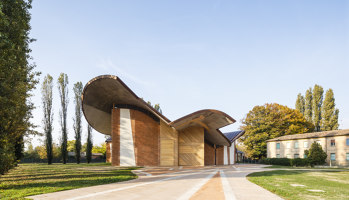
'Centrifugal Villa' by OBRA Architects
The New York based OBRA Architects recently realised this single family villa including a pool-house with a separate guesthouse and garage structure in Southampton in their home state.

Set on a 5-acre property overlooking an agricultural reserve, 'Centrifugal Villa' by OBRA Architects
Here is what the architects expalin:
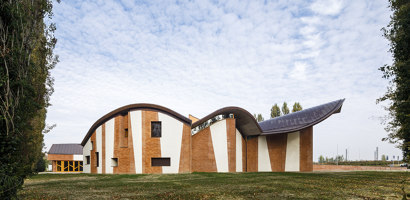
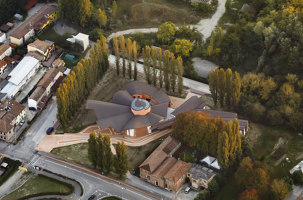
“The Centrifugal Villa is arranged around a hollow center, as if the heart of the house had somehow fallen outside its body. The string of subsequent spaces in its interior provide a comprehension of the whole by sacrificing their individual geometric cohesiveness to the fractured configuration of the entire composition.
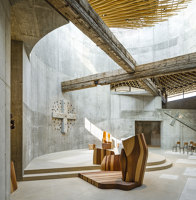
The experience of the interior is characterized by constantly shifting vanishing points, at the place of their collision in each crease of the plan, large openings cutting dormer scoops on the roof, centrifugally release the views out to the surrounding landscape.”

Garage, 'Cenrifugal Villa' by OBRA Architects
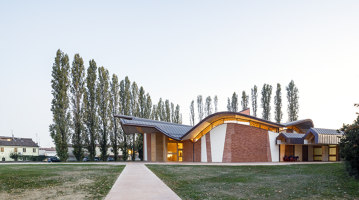
“The house, defined by this idea rather than a formal imposition, cannibalizes the local “vernacular,” distorting it through hexagonal introspection of the plan and the transposed proportion of the parts.
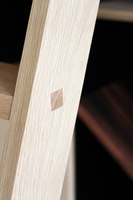
Designed as wood post-and-beam structure, the exterior cladding is detailed with vertical board and batten seams to give continuity to the building exterior and encourage an uninterrupted rhythmic flow around the elevations.”

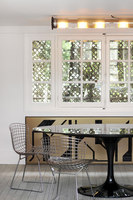
Dining room, 'Centrifugal Villa' by OBRA Architects

Gallery, Living room, 'Centrifugal Villa' by OBRA Architects

'Centrigual Villa' by Obra Architects

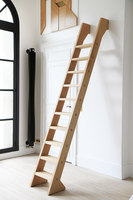
Staircase, 'Centrifugal Villa' by OBRA Architects
Architects: OBRA Architects, Pablo Castro, New York / Connecticut
Program: Residential housing, 7-bedroom residence, guest house, 4-car garage, poolhouse and tennis area
Area: 13,250 sf
Credits: OBRA ARCHITECTS Pablo Castro, Jennifer Lee
Project team: Selin Semaan, Akira Gunji, Luis Costa, Shin Kook Kang, Satoshi Kiyono, Kaon Ko, Bronwyn Kotzen, Fabiana Meacham, Elizabeth Snow, Elina Almuhametova, Chiara Filios, Doreen Lam
Structural Engineer: Robert Silman Associates, Nat Oppenheimer, Jeff Beane
Lighting consultant: Peiheng Tsai Lighting Design
to the OBRA Architects website
Red + Housing by ORBOS Architcets
The New York-based OBRA Architects was invited to acknowledge and mark the first-year anniversary of the Sichuan earthquake through participation in CROSSING: Dialogues for Emergency Architecture, an exhibition on emergency housing at the National Art Museum of China in Beijing.
“Working from New York City, we seek to take advantage of this opportunity to contribute to the victims of future catastrophe around the world by advancing disciplinary thinking about temporary emergency housing.”
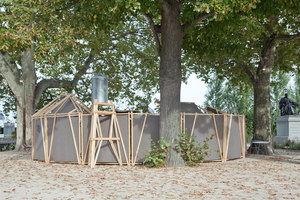
The completed full-scale prototype was exhibited in the entry courtyard to the Museum from May 12 to May 24, 2009.

Red + Housing by OBRA Architects
Architecture on the Edge of Survival involves the development of an original prototype of emergency housing for future potential deployment in areas of natural or man-made disaster anywhere in the world. Emergency housing from the point of view of design is only an extreme form of architecture. Its context is that of almost unsustainable conditions, and its object, the creation of an environment we can inhabit temporarily while living on the edge.
Red+Housing is proposed with the knowledge that, when living on the edge of survival, action needs to be decisive and precise. By definition, an emergency will arise suddenly and demand fast response, but the immediate actions we take can have long-term consequences.

Part of the concept: marking the disaster area with the emergency architecture
The design has been developed as an in-progress embodiment of the following 10 Points of Architecture on the Edge of Survival.
01. Universal Application
This prototype aspires to universal applicability. Its development contemplates a series of simple modifications that would make it a useful solution anywhere in the world: add insulation and a stove for cold climates; remove doors and windows for tropical climates; replace materials according with local availabilities, etc.
02. Effective Performance
The project makes economical use of materials by enlisting the structural strength of post-tensioning. The bamboo plywood strips of the dome support the enclosure, with the same force with which a bow propels an arrow into the sky.
03. Economical
The project proposes the use of locally available low-cost materials. The materials are always replaceable and are chosen for their performance rather than appearance. When working in different locations materials which become exotic can be replaced with ones that are locally abundant.

Construction
04. Transportable
All parts are collapsible to flats and can therefore be easily packed and transported.
05. Ease of Assembly
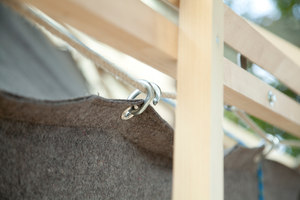
All connections are a simple friction bond of male/female parts which are then secured with a minimum of fasteners.
06. Renewable Materials
In China the project is proposed almost entirely in bamboo plywood, one of earth’s most renewable of materials. The cover fabric can also be considered as woven out of waterproof bamboo fibers.
07. Digitally Pre-fabricated
Digital pre-fabrication makes the project economical in its speed of production and also easy to assemble due to the precision of its fabrication.
08. Open Work
The cruciform house, while iconic, retains in its biaxial symmetry a certain ‘indifference’ that allows its easy recombination with other locally and diversely made structures.
09. Urban/Rural
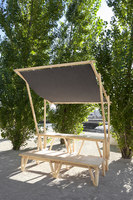
The geometry of the crosses, when deployed together in groups, defines in-between spaces of infinite flexibility that can suggest an ‘urban’ context for a field of houses. Likewise, if a house is erected by itself, the exterior of the cross creates spaces that mediate between interior and exterior providing a context for people to spend time outside.
10. Flexibility of Use
The geometry of the cross allows the inhabitation of the house as either 1, 2, 3, or 4 different units of housing.

Interior
The value and need of effective emergency housing is self-evident. There are, of course, a number of different approaches to be considered and our intent is to utilize the opportunity of the architectural design process to test and explore possibilities which might best benefit victims. We feel architecture has something to contribute not only to their physical but also to their emotional and psychological well-being. Under the extreme conditions of a situation of emergency, architecture is rarely called upon to participate in the creation of temporary housing. This exhibit provides an opportunity to test how “high design” can contribute to apparently pre-eminently pragmatic concerns. Emergency housing from the point of view of design is only an extreme form of architecture. Its context is that of almost unsustainable conditions, and its object, the creation of an environment we can inhabit temporarily while living on the edge.
Location: National Art Museum of China, Beijing, PR China
Architects: OBRA Architects, Pablo Castro and Jennifer Lee
OBRA Architects Project Team: Shin Kook Kang, Project Architect, Atsushi Koizumi, Sihyung Lee, Sara Kim, Orla Higgins, Michel Dinis
Special thanks to: National Art Museum of China, United Nations Development Programme China, China Central Academy of Fine Arts
to the OBRA Architects website