Posts tagged as 'library'
Library of the University of Amsterdam by Studio Roelof Mulder & bureau Ira Koers
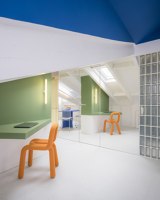
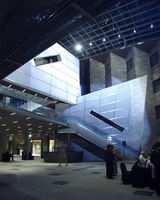
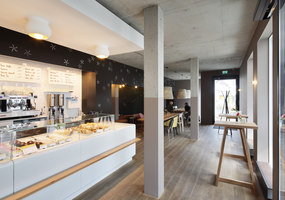
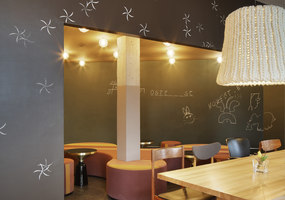
In close collaboration the Dutch practices Studio Roelof Mulder and bureau Ira Koers realised the new interior design for the Library of the University of Amsterdam. The project won The Great Indoors Award 2009 in the category Serve & Facilitate.

Library of the University of Amsterdam by Studio Roelof Mulder & bureau Ira Koers
“A library whose decor no longer consists of books has been turned into a ‘home’ in which to study.
The UvA’s enormous collection of books is kept in closed repositories, book depots and at various open locations. A growing number of students, anywhere from 1500 to 5000, visit the University Library every day in order to study and pick up their digitally ordered books. Despite plans for a new building in the future, the university wished to have a new, temporary interior design for the 2500 m2 space that would comprise study rooms plus 235 extra workspaces, the canteen, the information centre with its desk, the hallways, and an automated lending area.”

Library of the University of Amsterdam by Studio Roelof Mulder & bureau Ira Koers
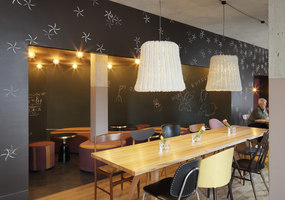
“To offer students a good second home, we wanted to achieve two important things: a space like the white page of a book where the students themselves would play the main role in determining how it is filled in, and in certain areas a domestic atmosphere where the students could also study informally.
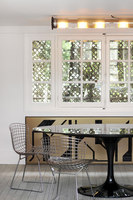
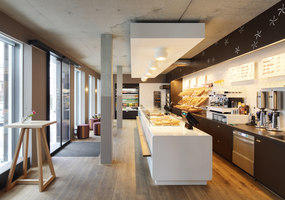
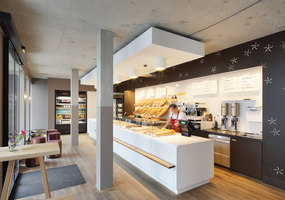
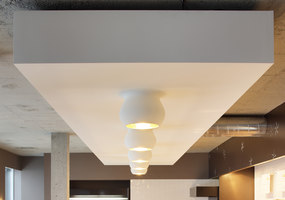
For instance, in one of the study rooms you will find a number of kitchen tables where you can work in groups under the lamp, a chesterfield couch for reading a newspaper, various sitting areas for a short break and special telephone areas in the hallways between the quiet study rooms. The columns in the canteen are transformed into illuminated trees with low energy light bulbs.”

Library of the University of Amsterdam by Studio Roelof Mulder & bureau Ira Koers
“Until recently, borrowed books could only be picked up at the library desk during office hours.
Now the students can pick up their ordered books themselves in a newly designed red room that is open until midnight, including weekends. In red cases with 1105 red crates, piles of books lie ready for the borrowers. Because these books come from different locations, this is the heart of the University Library, with a back office hidden from view in which the books are readied for self-service with the RFID system.”

Library of the University of Amsterdam by Studio Roelof Mulder & bureau Ira Koers

Library of the University of Amsterdam by Studio Roelof Mulder & bureau Ira Koers
to the bureau Ira Koers website
to the Studio Roelof Mulder website
Open Air Library in Magdeburg, Germany by KARO Architects, photo by Anja Schlamann
The Leipzig-based KARO Architects realised this 24 hours open air library southeast of Magdeburg, one of the urban areas in Eastern Germany which are characterized by abandoned industrial plants and fallow land. After temporary installation made of used beer crates in 2005, this summer the finished library opened officially.
Does the structure seem familiar? Indeed the architects re-used the standard modernist facade of an old HORTEN warehouse of the City of Hamm, built in 1966, which has been knocked down in 2007.

Open Air Library by KARO Architects, photo by Anja Schlamann
Brief project description
“The open air library, we established in 2005 in an abandoned district centre in East Germany. The project has been started with a public intervention, using beer crates as building material: On the fallow site of the former district library a 1:1 model of a possible Open-Air-Library has been build up for two days and the shelves have been filled with book donations. The residents took over the energy of the temporary project and opened up an informal district library near the site which now offers more than 20.000 books. The outdoor space as an addition has been designed together with the residents and opened in June this year.”

photo by Anja Schlamann
Project Information
“The southeast of Magdeburg is a post-industrial city landscape with high unemployment and figures of vacancy up to 80%. This also concerns the district Salbke. The spatially intact city center stands almost completely empty. Its image is shaped by pasted over shop windows and fallow land. The encountered reality served us as a resource and starting point for an urbanistic experiment.”

Open Air Library by KARO Architects, photo by Anja Schlamann
“In collaboration with the local residents the fallow zones of the former village library are developed as a “bookmark”. Rememberance, history and narratives provided the background for the “re-occupation” of the abandoned expanse. An old empty shop was used as base for a temporary library and camp for a building workshop. There, books were collected and design strategies for reclaiming the site were developed.
With more than 1.000 lent beer crates the favourite draft was constructed together with the locals in the scale 1:1 [2005]. The shelves of the temporary library were filled by the residents with books. A festival followed with poetry slam and readings to prove the everyday suitability of the new urban situation. Since 2005 more than 20.000 books were collected and the local residents pursue a reading café quite near the site. But it took some years to organise the money to build this so called “bookmark” for real. Since 2006 the project is part of a research project of the federal government and is funded as a pilot project for realisation.
In June this year the outdoor-library opened officially. The residents which take care for the reading-café as well as for the open-air-library call it a “library of confidence”: There is no registration needed. You can just take a book away and should bring it back voluntary or at least another one. The shelves are never closed; you can go there and take a book when ever you want – 24 hours a day.
As another communal function a stage is included. This is used by the elementary school for theatre plays, as well as for public readings, for concert-gigs of local youth bands and other cultural and communal events. ”

Open Air Library by KARO Architects, photo by Anla Schlamann

Open Air Library by KARO Architects, photo by Anja Schlamann
Project Title: Lesezeichen + Stadtregal Salbke
Architects: KARO*, Antje Heuer, Stefan Rettich, Bert Hafermalz, Leipzig Architektur+Netzwerk, Sabine Eling-Saalmann, Magdeburg
Collaborators: Christian Burkhardt, Gregor Schneider, Mandy Neuenfeld
Project Partners: Bürgerverein Salbke, Fermersleben, Westerhüsen e.V.
Structural Engineer: Michael Kurt, Leipzig
Light Conception: Jürgen Meier, architektur&medien, Leipzig
Consultant: Ruth Gierhake, Köln
Commissioner: City of Magdeburg
Funding: Ministry of infrastructure, building and city development
Building Costs: 325.000 Euro
Site: 488 square meters
Construction: Nov. 2008 – June 2009
to the KARO* Architekten website
to the Anja Schlamann website
Mon 12.10.
Posted by Nora Schmidt on 12.10.2009 - Tagged as: Germany, library, Max Dudler
Jacob-und-Wilhelm-Grimm-Zentrum in Berlin by Max Dudler Architects, photo by Stefan Müller
After more than three years construction time today the new Jacob and Wilhelm Grimm Center in Berlin – Germany’s biggest open access library – will be opened. The library of Berlin’s Humboldt University was designed by the Berlin, Franfurt and Zürich based Max Dudler Architects.

Jakob-und-Wilhelm-Grimm-Zentrum by Max Dudler Architects, photo by Stefan Müller
The Jura-marble façade, which quotes the typology of a book shelf, represents the inner function of the rather classic, geometric building and also refers to a draft of Friedrich Schinkel from 1833 who has been working on a University Library.

Jacob-und-Wilhelm-Grimm Zentrum by Max Dudler Architects, photo by Stefan Müller
The central reading hall is the building’s core. With its strict symmetry and impressive galleries it creates a common culture space in the sense of the “old library”.

Reading hall, Jacob-und-Wilhelm-Grimm-Zentrum, photo by Stefan Müller

Jacob-und-Wilhelm-Grimm-Zentrum by Max Dudler Architects, photo by Stefan Müller
Design Team: Max Dudler, Andreas Enge, Jochen Soydan (project management) Andrea Deckert, Gesine Gummi
Client: Humboldt-Universität zu Berlin
User: ZE University Library, ZE Computer and Media Service
Construction period: 06/2006 – 10/2009
Main usable floor space: 20.300 m2
Gross Floor Area: 38.300 m2
Gross Cubic Volume: 144.000 m3
Site area: 6.673 m2
Photographer: Stefan Müller
Partners: ProCon Ingenieursgesellschaft mbH, Zibell, Willner + Partner VBI, GmbH, Döpping Widell Dipl.-Ing- Architekten, Müller BBM Brandschutz GmbH
to the Max Dudler website

Sherman Contemporary Art Foundation Bibliotheca by LAVA
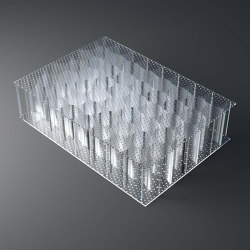
A new architectural installation commissioned for the first anniversary of the Sherman Contemporary Art Foundation (SCAF) in Sydney creates a spectacular space for displaying catalogues and other publications. Designed by LAVA changing lights and effects will adapt and grow in response to each new gallery project creating an ephemeral and surreal experience.

The installation showcases LAVA’s ongoing fascination with the efficiency and beauty of geometries in nature – the potential for naturally evolving systems for new building typologies and structures.
The installation is an evolutionary display, which will adapt and grow in response to each new gallery project while creating an ephemeral and surreal experience with changing lights and effects. mHolding a selection of Sherman Contemporary Art Foundation and Art & Australia publications in honeycomb shaped cells, the installation is backlit through transparent acrylic via energy efficient LED lights.

The bookcase uses the latest digital fabrication and engineering techniques such as CNC milling and CAD CAM technology. LAVA maintained a 'digital chain' throughout the design and production process, which has established offices in Sydney, Abu Dhabi and Stuttgart over the past 12 months.
“The shape of the installation is based on a ‘voronoi’, or ‘bubble geometry’ “, Dr Gene Sherman, director of Sherman Contemporary Art Foundation who commissioned the work said, “LAVA`s installation possesses an aesthetic that resonates throughout the gallery space while being surprisingly functional.”
to Sherman Contemporary Art Foundation
to LAVA
Seville University Library, designed by Zaha Hadid Architects
Residents are said to have disapproved of the loss of land surrounding the library including planting. Even though the 250 removed trees and 500 shrubs were transplanted elsewhere in an effort to ensure the trees were not wasted, a ruling has been made by the Andalusian high court against the continuation of works at Seville University Library – the site of Zaha Hadid’s dramatic 9,000 sq m building.
Despite the ruling, construction which is already underway, will continue: “Works continue at the construction site of the University of Seville Library,” said a spokesperson for Zaha Hadid. “Projects such as this library – offering a wide variety of civic, cultural, educational and research programmes – are vital for every community. As the university has outgrown its existing facilities, the new library is essential for the university’s development and reflective of its deep commitment to the future of Seville.

Public prompt ruling against Seville University Library design
“The Government of Andalucía, the Seville City Council and the University of Seville will be appealing the ruling. All construction works continue as normal throughout the appeal process,” he added.

Seville University Library designed by Zaha Hadid Architects
more info at World Architecture News

The fragmented facade
At the beginning of this year, the International Year of Astronomy, the Cahill Center for Astronomy and Astrophysics opened its doors in Pasadena, California. The Center was designed by the Californian firm of architects Morphosis and named after its generous sponsor Charles H. Cahill, who helped finance a large share of the 50 million dollar building.
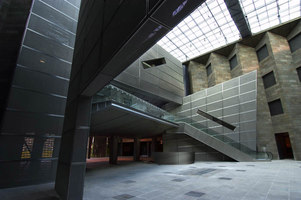
The terra cotta facade of the 100,000 square-foot structure has a fragmented look. Folds and cracks in the design, which is in many respects fairly conventional, give the impression that the forces of nature have had their effect on the building – appropriate, even if the Institute for Seismology in its colonial style premises is right next door.

The central staircase
more about the Cahill Center for Astronomy and Astrophysics
to the Federal Building in San Francisco by Morphosis