(765)
(431)
(214)
(157)
(95)
(1539)
(105)
These video shows the installation “Flight Assembled Architecture” of Gramazio & Kohler and Raffaello D’Andrea’s flying robots.

Flight Assembled Architecture © Gramazio & Kohler and Raffaello D’Andrea in cooperation with ETH Zurich
Flight Assembled Architecture is the first installation to be built by flying machines. Conceived as an architectural structure at a scale of a 600 m high “vertical village”, the installation addresses radical new ways of thinking and materializing architecture as a physical process of dynamic formation. Gramazio & Kohler and Raffaello D’Andrea developed a powerful expression of cutting-edge innovation that uses a multitude of mobile agents working in parallel and acting together as scalable production means.
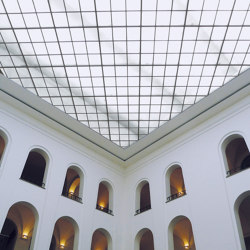
Take a training in structural-engineering draughtsmanship, the rational, pared-down aesthetic of the Swiss, and the talent of a natural designer and you get Hannes Wettstein, the creative whose furniture, product designs and interiors form a memorable body of work with an emphasis on simplicity of form. The material legacy of Wettstein, who died far too young in 2008, is currently being celebrated in Zurich at the Swiss Federal Institute of Technology (ETH), where an exhibition in its striking main hall combines the display of some of his archetype-defining products with large-scale projections of his sketches. Architonic was there, of course, and offer you some photographic impressions of the installation-like show.
to Architonic’s ‘Hannes Wettstein, 1958-2008′ photo gallery
An exhibition dedicated to the indisputable talent of the late Swiss designer Hannes Wettstein will open on 6 October in the main hall of ETH Zürich. His most important works including ‘hundreds’ of sketches as well as furniture, products and interior designs will be on display at the show.
‘Hannes Wettstein, 1958–2008′ exhibition was organised by the Zürich-based Studio Hannes Wettstein and will be presented by ETH’s Institute for the History and Theory of Architecture (gta).
read more about the ‘Hannes Wettstein, 1958-2008′ exhibition on Architonic
Prototype, 1:1 scale
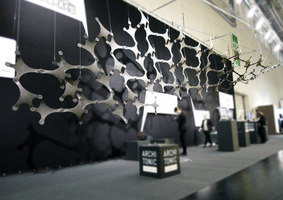
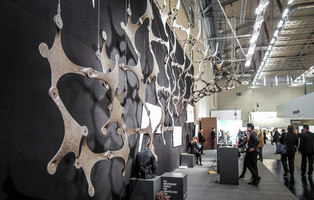
The final design has been ready since the New Year, and production began one week ago. Architonic Concept Space III, designed by Oskar Zieta (Zieta Prozessdesign) and the CAAD faculty at the ETH Zurich will be celebrating its premiere to coincide with the opening of this year’s imm cologne on 19 January. In the second part of our ‘Making of’ report we would like to provide you with a few more insights into the manufacturing process.

Building the final prototype
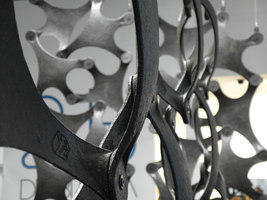
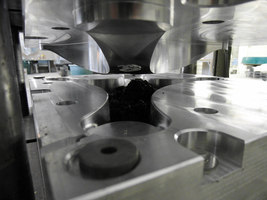
It has to be modular and adaptable to varying stand sizes, easy to set up and dismantle time and time again, convenient to transport on a single truck etc. – this was the challenging briefing for the Architonic Concept Space. For Zieta it was an ideal opportunity to offer an initial demonstration of the versatility of his FiDU (Freie InnenDruck Umformung) light construction technique in an architectural context. This highly flexible technology, in which precision-cut and welded sheet metal sections are blown up under high pressure to form three-dimensional shapes, could almost have been created specially for this demanding task.

Knot
The result is a modular structure consisting of identical, inflated sheet metal modules. Depending on the stand size they can be placed next to one another, behind one another and even on top of one another. The core of the entire construction is the connecting points which bind the whole structure and distribute the forces involved across the supports and cross members, stabilising it in all directions.
Monte Rosa lodge with Matterhorn, Photo: ETH-Studio Monte Rosa/Tonatiuh Ambrosetti
Life threatening conditions, abode of trolls and witches:
The Alpine inhabitants of the Middle Ages avoided the mighty peaks and icy heights of the high Alpine regions. Nowadays they are accessible for tourism. Alpinism the way we know it today dates back to Romanticism, which is when several Alpine associations like the German Alpine Society (Deutscher Alpenverein) or the SAC (Swiss Alpine Club) were founded. They provided basic lodges or camps to their members. Today, on the one hand great care is taken of the Alpine environment, while on the other hand the needs of Alpine tourism must be attended to. Lately this field of tension has given rise to a few buildings worth mentioning.

The silvery, shining aluminium cladding reflects the mood of the light, Photo: ETH-Studio Monte Rosa/Tonatiuh Ambrosetti
Modern architecture 2883 metres above sea level: the new SAC lodge Monte Rosa
Alpine construction, with its extreme conditions, remains a challenge in engineering, as shown by the recent example of the Monte Rosa lodge.
The Swiss Federal Institute of Technology (ETH) took over the architectural and technical concept, creating a crystalline body with remote-controlled energy management from a computer at the ETH in Zurich. The energy needed for heating water and air come from solar collectors. The sewage is micro filtered on a bacterial basis and the resulting greywater is reused for flushing and cleaning purposes.
The silvery, shining aluminium cladding and the photovoltaic structure on the southern facade conceal the wooden construction beneath. Inside, the building is more homey, the Alpine crystal has a warm, soft core and you can carve your name in the restaurant furnishings.

The dining hall of the Monte Rosa Lodge, Photo: ETH-Studio Monte Rosa/Tonatiuh Ambrosetti
'Pike Loop' in Manhatten
During four weeks a robot of the ETH Zurich will built the ‘Pike Loop’ installation on a traffic island in the middle of New York. From 5 October passersby will be able to follow the construction of the bending brick wall, which will be finished 27 October and last until the end of the year. The installation and its unique construction method was developed by the professorship of Gramazio & Kohler ‘Architecture and Digital Fabrication’ at the ETH Zurich. The research of this professorship will be presented within the attendant exhibition „Digital Materiality“ in the „Storefront for Art and Architecture“ gallery from 1 October til 14 November.

'Pike Loop' by Gramazio & Kohler
Here is what the architects explain:
“Pike Loop is a 22m (72ft) long structure built from bricks, the most traditional building material widely present in New York. It was designed to be built on-site with an industrial robot from a movable truck trailer. More than seven thousand bricks aggregate to form an infinite loop that weaves along the pedestrian island. In changing rhythms the loop lifts off the ground and intersects with itself at its peaks and valleys. The massive weight of the bricks is brought to a delicate suspension. The digitally designed brick structure is further articulated by a weighted compressing and tensioning of the brick bond. Where the loop flies the bond becomes stretched and thus lighter; where it brings loads to the ground it becomes jagged and heavier, thus wider and more stable.”

Plan
“The continuous form and homogeneous expression of the structure can only be achieved through on site digital fabrication. The structure is built using the robotic fabrication unit R-O-B housed in a transportable freight container. R-O-B was shipped from Switzerland to New York and loaded onto a low bed trailer for transport and onsite fabrication. The moving of the truck trailer shifts the 4.5m (15ft) work area of R-O-B along the site in order to build the complete structure.”
Client: Storefront for Art and Architecture in conjunction with the New York City Department of Transportation’s Urban Art Program
Collaborators: Michael Knauß (project leader), Ralph Bärtschi, Markus Giera, Michael Lyrenmann, Kirsten Weiss, Brett Albert, Marc Pancera, Tom Stewart
Selected experts: Buro Happold Consulting Engineers, P.C. (Structural Engineering)
Sponsors: ETH Zurich, Faculty of Architecture
Keller AG Ziegeleien
Consulate General of Switzerland in New York
Swiss International Airlines
General Shale Brick Inc.
USM Modular Furniture
Pro Helvetia
Sika Schweiz AG
Buro Happold Consulting Engineers, P.C.
Graham Foundation for Advanced Studies in the Fine Arts
New York State Council on the Arts
New York city Department of Cultural Affairs
to the professorship’s website
to the Making of Architonic Concept Space II by Gramazio & Kohler