This year DMY Berlin offers a special discount for early adopters: In case your project will be selected for the festival participation, you will save 20 % for the stand rental, if you apply for one of the modules until December 31, 2009.
The next edition of the DMY International Design Festival Berlin will take place from Wednesday, June 09 until Sunday June 13, 2010 at tresor.m, Berlin.
At this year’s DMY Festival in Berlin we discovered this series of delicate light objects by the German designer Markus Becker. ‘Perelin’ consists of four different self-supporting objects made from an artfully bent glossy electroluminescent glow sheet.
'Objekt 1' by Markus Becker
“These lights made from EL-foil are very light, thin and flexible, almost like paper. They provide indirect lighting and are definded by being twisted onto themselves. The contrast between back and front side, between luminous and non-luminous surface creates a striking black-and-white effect.”
An event created by Fantastic Norway as part of the DMY International Design Festival 09 in Germany / Berlin. In the project members of Fantastic Norway were wearing models of high-rise towers while walking, cycling and dancing around the city. They dressed up as their latest building and went sight seeing around Berlin.
”The walking houses are man-sized models of our latest architectural project: a tourist destination located on the northern west coast of Norway. As our project depend on the idea of travelling, we decided it was only fair that the houses got to do some travelling too!”
They dressed up as their latest building and went sight seeing around Berlin.
The project consists of a group of narrow high-rise modules welcoming the guests of the Norwegian west coast. The systematic and flexible module-system allows the outdoor spaces, the miniature high-rise modules and the interiors to be designed in collaboration with the future inhabitants and selected artists. Interacting with the locals of Berlin, the event emphasizes the project’s social and local ambitions.
Interacting with the locals of Berlin.
Architectural team: Håkon Matre Aasarød, Erlend Blakstad Haffner, Magnus Ohren, Tomos Osmond, Anne Busemann, Mathias Steinbru, Anette Flygansvær, Ingeborg Cappelen Lindheim, Renata Barros and Håvard Arnhoff.
DMY Allstars at the IMA Design Village, Photo: Tobias Götz
For five whole days the organisers of the DMY Festival invited designers and a specialist public from all over the world to a colourful design spectacle by the Spree. We were impressed this year by DMY Berlin in its role as a presenter and communicator of design. The DMY has now achieved a credible position as a pure design event, without leaving the unpleasant after-taste of being simply a product trade fair in disguise. With an enormous increase in the number of exhibitors and a much wider programme of events the festival has escaped from its ‘new kid on the block’ image, and has established itself as a well-curated platform for progressive design concepts.
DMY Symposium: Li Edelkoort, Daniel Schwaab, Arik Levy, Photo: Federico Testa
Focusing the exhibition on two main locations this year has proved itself to be a good decision, with the DMY Youngsters show at the Arena in Treptow for the first time being supplemented by an exhibition featuring the DMY Allstars at the IMA Design Village, an old brick factory in the heart of Berlin Kreuzberg. Here 150 more or less established designers, related festivals and curated exhibitions -for example Designhuis from the Netherlands –presented their creations. In the Arena up-and-coming designers and schools of design showed their works on a generous area of 7000 m². The size of the area provided plenty of space for extensive installations and created an inspiring atmosphere — giving it a decisive advantage over the effective but less original Milan ‘box system’ of the Salone Satellite. Another attractive feature was the refreshing mixture of established and up-and-coming designers, which rather undermined the differentiation between Allstars and Youngsters. As a result it was difficult to define specific differences between the two locations.
The attraction of the festival in terms of content was accentuated above all by a well chosen accompanying program: the DMY Symposium in the slightly shabby but all the more charming ‘Kunstfabrik’ included lectures, roundtable discussions and workshops led by prestigious designers such as Chris Bangle, Arik Levy and the well-known trend researcher Li Edelkoort, who had previously surveyed the work of the Youngsters in the Arena. One thematic focus of the symposium was ‘Alternative Strategies’. On this subject, for example, the designer Jerszy Seymour, a resident of Berlin, explained his almost ’situationist’ interpretation of product design. With his often improvised and amateurishly implemented objects the Canadian calls into question the mechanisms of industrial production techniques. The Israeli designer Ronen Kadushin responded to the challenge of finding alternative design strategies with his interdisciplinary concept of ‘open design’, in which he transfers to product design the open source idea — in other words the global and creative cooperation among designers, manufacturers and dealers.
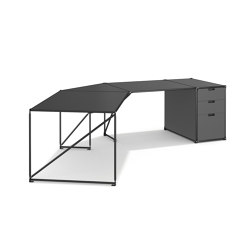
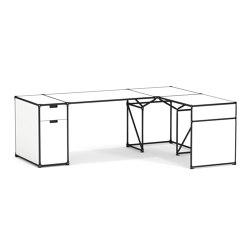
At this year´s DMY Festival the Berlin-based designers of Atelier Haussmann presented ‘Affe’ a multi-prupose table which consists of adjustable trestles made from oiled crude steel and variable shelves and slabs.
‘Lackaffe’ is a second version with lacquered trestles.
Almost all of his works remind of architectural constructions, but the latest piece of the German designer Jens Otten is definitely the most delicate one.
Inspired by the construction of lattice truss Jens created an ergonomic and flexible seat shell made of 1,5 mm birch plywood. The elements of the shell are cut by a CNC machine and the shape is definded by the exact pattern of these pieces. The whole chair has a weight of 2 kg.
'Modulares Licht' ('modular lighting') by Robert Hoffmann
The German designer Robert Hoffmann presented this series of lamps at the DMY festival in Berlin this year.
‘Modular Lights’ (’modular lighting’) are adjustable luminaries made of aluminium and steel. The basic technical structure with illuminants and joints bears the outside surface. By spinning and tipping the outer flats, the inner light-room of the ashlars breaks open. The spatial reception is changed. Slim lines of light transform into flats of light. The variability of the modules enables surprisingly new light-room-constellations.
Yeayea is not a band from New York but two designers from Leipzig, Germany – Johannes Heinzmann and Franz Gabel.
At this year´s DMY Festival in Berlin they presented pendant light ‘Linienlampe’ made of three neon tubes. According to the height of the ceiling the spare cable can easily be wrapped around the joint which is made of heat resistant silicon.
The Swiss designer Olivier Sottas presented at this year´s DMY Festival in Berlin ‘Plié’, a series of floor lamps. The lamps are composed of a paper lampshade, which gets its structure and stability from the artful folding, and a base made of thin plywood pieces. Unassembled it can be sent flat-packed. For its lightness and its biodegradable materials ‘Plié’ is impressive in terms of sustainability.
The group of 13 German/Italian designers ‘Transalpino’ exhibited and worked for seven days during this year´s DMY Festival in their beautiful exhibition space in Berlin´s Prenzlauer Berg borough. With their experimental exhibition the designers processed waste material from a veneer factory – a material which is easy to manipulate with basic tools. The results were “ad hoc objects” and abstract shapes, which nicely adorned the wall.
Wall lamp at 'Transalpino'
“Our focus is not on the end product but on interaction, as well as testing and discovering the limits of designing in a public space. It doesn’t just showcase finished products but also “open progress”, in other words the group and the work themselves. Here, ideas and inspiration are shared, with none of the usual references to who has designed what. This theme is continued in the workshop rules: “Adopting ideas is encouraged”, “Copyright-free zone” and “No mass production”.”
From a fruitbox to a chair: 'Transalpino' in Berlin
The Independent Source for Products, Materials and Concepts
Fascinating World of Design for Modern Kids
Broadcasting Architecture Worldwide
International Architecture News
Online Design Magazine