Posts tagged as 'Concrete'

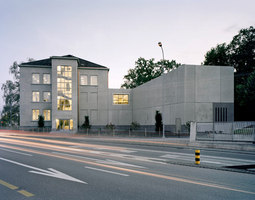
'Knocktopher Friary' by ODOS Architects
The Irish practice ODOS Architects realised this extension and refurbishment of an existing protected friary building in Knocktopher, Co. Kilkenny. Since the original collection of extensions and structures to the rear of the Friary building and adjoining Church were demolished the Dublin based architects were commisoned to design a new master plan for this small complex of buildings around a new central courtyard.
(more…)

'JD House' by BAK arquitectos, photo by Gustavo Sosa Pinilla
Last year the Buenos Aires based architectural practice BAK arquitectos finished this massive single family villa on a sloped lot in the forest around the Argentinean capital.
(more…)

'Villa M' by Niklaus Graber & Christoph Steiger, photo by Dominique Marc Wehrli
The Lucerne based architectural practice Niklaus Graber & Christoph Steiger Architekten realised this luxurious single family home on Lake Lucerne. The cubic concrete multi-structured construction is characterised by a vertical staggering which divides the linear plot of land into different areas and offers incomparable views and different sunny positions. Forecourt, court terrace and shore zone form a sequence of specific venues that accompany the inhabitants and visitors from the roads to the lake.
(more…)

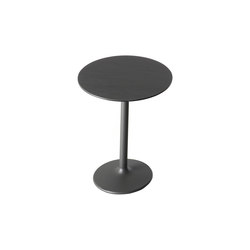
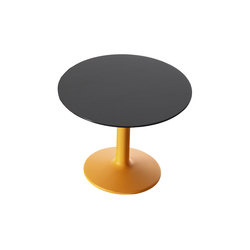
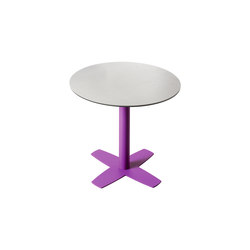
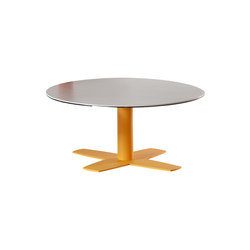
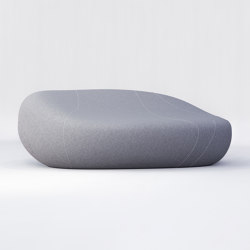
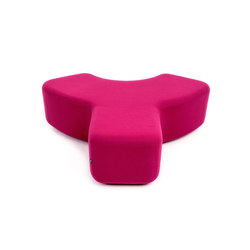
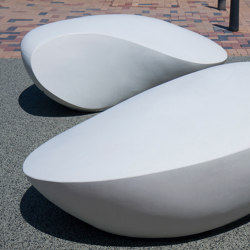
'Mushroom' stool by Cilicon Faytory
The Singapore based design studio Cilicon Faytory realised these series of in- and outdoor furniture. ‘Coner’ consists of differently shaped stools, benches and tables made from light weight concrete which allows different colours to be applied. Due to a special sealing the furniture is virtually free of maintenance.
(more…)

'Las Lomas House' by Estudio Ramos, photo by Eduardo Torres
This broad 635-square-meter home amidst a dense foliage of aged trees was designed by the Buenos Aires based architectural practice Estudio Ramos. Its massive construction, especially the front façade is characterised by beams, slabs, column, and walls of reinforced concrete and builds a strong contrast to the back elevation, which is practically all glass.
(more…)

Coat rack by Vytautas Gecas
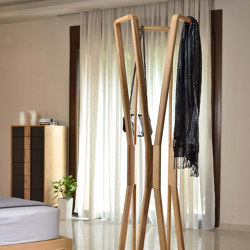
The young Lithuanian designer Vytautas Gecas designed this simple coat rack consisting of a heavy concrete base and a bunch of wooden sticks. There is not much more to say about it, that’s why it is so smart.
(more…)

A glazed window has been tucked into the front opening
The Truffle, aka “La Trufa”, is a piece of architecture that is not only characterised by its distinctive form, but also its extraordinary process of development.

Cutting the concrete with a quarry machine
As real truffles do, the shape of the hollow concrete rock “grew” in the earth. A hole was dug in the ground and the concrete was poured inside. To retain a hollow space within “La Trufa”, hay bales have been included in the volume.

Detail of the silicon-glazed window
To get rid of the hay from the interior, a calf called Paulina was brought in; she enjoyed 50m3 of the nicest food, which she ate for a year. She left a healthy adult, weighing 300 kilos.

Entrance into the core of "La Trufa"
After that, a quarry machine was used to reveal the core again and create openings. The small holiday house situated on the Costa da Morte in Spain provides a shower, toilet and a bed with a view, but, as the project’s name “La Trufa” suggests, a kitchen wasn’t necessary: the Spanish Atlantic coast boasts of a wide range of restaurants which impress even spoiled gourmet food lovers.

The bed with a view is located directly in front of the generous window, which floods the cave-like interior with light

Although the inside seems to be hewn out of natural rock, the volume has been constructed out of concrete

La Passarelle Pietonne by maison d'art'chitecture, photo by Serge Grard
This beautiful pedestrian bridge over the newly built Highway H10 in Corcelles-Cormondrèche, in the western French speaking part of Switzerland was designed by the local architectural practice maison d’art’chitecture. The overpass consists of two major elements: one the one hand the ponton-like ramp made from concrete and worked stone from the Jura Mountains – on the other hand the actual gangway constructed from glued-laminated timber. The dynamic shape of the bridge goes back to the existing inclination of the constrcution site and the winding street trading.

La Passarelle Pietonne by maison d'art'chitecture, photo by Serge Grard

La Passarelle Pietonne by maison d'art'chitecture, photo by Serge Grard

La Passarelle Pietonne by maison d'art'chitecture, photo by Serge Grard

La Passarelle Pietonne by maison d'art'chitecture, photo by Serge Grard
to the maison d’art’chitecture profile @ Architonic

'Light House' by WOOD / MARSH ARCHITECTURE
This single family residence in Hawthorn, Victoria in Australia was designed by the Melbourne based WOOD / MARSH ARCHITECTURE. The two storeyed pavilion is composed of three volumes. One of them is the expressive and massive concrete upper level – it encases the bedrooms and appears to be floating over a glazed ground level.
'Light House' by WOOD / MARSH ARCHITECTURE
“The ground floor level houses the living spaces. In contrast to the suspended shell it is a glass pavilion that gives the upper level its identity and proudly supports it to be viewed from the street. The ground level transparency ensures the living areas are open to the surrounding landscape but remain protected from harsh weather by the cantilevered floor over. Walls on this level are located away from the perimeter envelope and service areas, such as the kitchen, are located within a central pod. This further enhances the reading and integrity of the pavilion in the tradition of Mies van der Rohe.
The structural columns that support the mass of the upper level are offset from the glazing line to emphasize the weightlessness of the principal concrete form, at the same time creating an internal colonnade that visually draws the occupants through the circulation spaces.”

'Light House' by WOOD / MARSH ARCHITECTURE
“The third glazed volume encloses the indoor pool, and slips beneath the suspended concrete shell of the first floor. This form is further articulated and differentiated by an expressed steel portal frame. The length of the pool is amplified by the low ceiling and the surrounding ivy garden walls.
Concrete was chosen as the predominate structural and expressed material to create a greater thermal mass and to allow the building to store energy over a longer period of time. The ground level windows are double glazed insulated units with a selected performance glass. The selected materials and construction type produce a quality building with outstanding longevity both in design, durability and energy efficiency.”

'Light House' by WOOD / MARSH ARCHITECTURE

'Light House' by WOOD / MARSH ARCHITECTURE

'Light House' by WOOD / MARSH ARCHITECTURE
to the WOOD / MARSH ARCHITECTURE profile @ Architonic

House in Lumino, photo by Enrico Cano, Como
This monolithic single family house, located in the Swiss Alpine village of Lumino, north of Bellinzona, was designed by the Lugano based studio Davide Macullo Architetto. The reinforced concrete structure of the building recalls the revered strength of the local traditional stone built houses, many of which date back centuries and are marked by their use of this single construction material.

House in Lumino, photo by Enrico Cano, Como
“In addition to the local scale references and material cues siphoned from the physical context, the concept and approach to the project was further influenced by the clients’ expressed desire for a minimalist aesthetic, both internally and externally. As such, the quality of the spaces in the house would be defined explicitly by the architecture and not by objects placed within it. The idea of the ‘minimalist monolith’ was adopted as the conceptual generator of the project and became a principle applied to all elements of the both the functional and construction programme, from the foundations up to the smallest finishing details.”

House in Lumino, photo by Enrico Cano, Como
“The geometry of the plan is generated by two shifted parallelepipeds and follows the fall of the site. The typology created by this staggered geometry underlies both the peculiarities of the landscape while also offering each of the levels a direct relationship with the surrounding gardens. The double system of vertical connections, one internal and one external, relates all the spaces of the house in a spiral movement and is in a constant play with its new inhabitants’ perception of time and scale. What is interesting about the house is the ability of the spaces to expand and extend into the landscape, allowing the external become part of the composition. While the individual spaces may be defined geometrically, each space flows into the next and continues to the external.”

House in Lumino, photo by Enrico Cano, Como

House in Lumino, photo by Enrico Cano, Como

House in Lumino, photo by Enrico Cano, Como
more information about the project @ Architonic
to the Davide Macullo Architetto profile @ Architonic