Posts tagged as 'Canada'

'Cappello' by molo
The Canadian manufacturer molo, especially known for its sophisticated paper furniture and room deviders, recently unveiled a new floor lamp. ‘Cappello’ is lit by LED. The lampshade, a paper “cap” – or cappello in Italian – is set upon a cylinder of soft white Carrara marble. The cylinder piece actually comes out of the hole bored through the marble block-shaped base for Arco, the iconic floor lamp designed by the Castiglioni brothers and manufactured by Flos.
(more…)

'Cloud Softlight' by molo
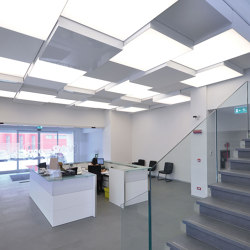
The Canadian manufacturer molo is specialised in flexible honeycomb structures made from paper and textiles of which they create room deviders, furniture and interior lighting. ‘Cloud Softlight’ is the newest product of the Vancouver based company. It is available in four different sizes and can create a luminous overhead canopy, hung in clusters, tailored to the individual space they are shaping. Light source: LED
(more…)

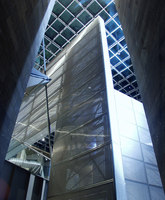
The Integral House, photo by James Dow, Edmonton, Albert
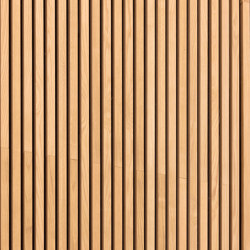
The Toronto based practice Shim – Sutcliffe Architects realised this house for architecture, music and performance located at the edge of a Toronto ravine. With a discerning eye for the detail the duo created a premium venue which is characterised by serpentine walls made of vertical glass separated by projecting oak fins.

The Integral House, photo by Ed Burtynsky, Toronto
“The section of the house parallels the experience of descending the ravine slope as well as ascending above into the tree tops. The key moment in your journey through the project is a performance space for 150 people to gather located a full floor below your entry level and visually intertwined with the ravine landscape. Upper level dining and living areas double as balconies during a performance providing additional seating overlooking the performance space.
Each of the project’s five stories on the ravine side has a different and emphatic relationship to the ravine landscape. At the lower floors, the experience of the forest floor is primary. As one ascends through the house, both the palette and spatial experiences lightens until you are in the airy tree tops.”

The Integral House, photo by Ed Burtynsky, Toronto
“Sustainability is integrated into the project and not considered as features. Beneath the entry driveway, twenty-three geothermal pipes provide heating and cooling for the main performance space and rest of the residence. The demands of an assembly space for larger events and gatherings necessitated an approach that is simultaneously energy efficient and also extremely quiet both inside and outside given its prime location in the heart of a large urban metropolis and along a ravine edge. The project’s extensive green roof reduces the heat island as well as being a visual feature viewed from many parts of the project. The vertical wooden fins provide sun shading on the exterior as well as contributing to the acoustical performance of the performance space on the interior. Materials have been selected for their aesthetic contribution as well as their enduring qualities based on life cycle costing calculations.”

The Integral House, photo by James Dow, Edmonton, Alberta

The Integral House, photo by James Dow, Edmonton, Alberta

The Integral House, photo by Bob Gundu, Toronto
to the Shim – Sutcliffe Architects profile @ Architonic

'28.7' by Omer Arbel for Bocci
In collaboration with the Vancouver based designer Omer Arbel, the Canadian manufacturer Bocci realised this new series of suspension lights.
“28 is a result of a glass blowing technique developed by Omer Arbel whereby air is intermittently blown in and then sucked out of an intermittently heated and then cooled glass matrix.”

'28.7' by Omer Arbel for Bocci
“The result is a distorted spherical shape with a composed collection of inner shapes, one of which houses a low voltage (12V, 20W halogen/xenon) or LED (12V, 0.3W) lamp.”
Due to this process every ’28′ is slightly different and therefore unique.

'28.7' by Omer Arbel for Bocci
’28′ comes in different sizes – from ’28.1′, with only one sphere, up to ’28.19′.

'28.19' by Omer Arbel for Bocci
more Bocci products @ Architonic
Fri 4.12.
Posted by Nora Schmidt on 04.12.2009 - Tagged as: boat house, Canada, gh3, studio
Photographer’s studio and boat house by gh3
This photographer’s studio and boat house designed by the Toronto based gh3 architects is one of the entris of the WAN Awards in the Residential section.

'William's Studio' by gh3
“Photographer’s Studio and Boat House on Stoney Lake is a reimagination of the archetypal glass house in a landscape. A continuation of thinking about this architectural ambition, the central conceit of the glass house is reconceived through a contemporary lens of sustainability, program, site and amenity. The compelling qualities of simple, open spaces; interior and exterior unity; and material clarity are transformed to enhance the environmental and programmatic performance of the building, creating an architecture of both iconic resonance and innovative context–driven design.”

'William's Studio' by gh3
“The program envisions a building as north–facing window: a photographer’s live/work studio that is continuously bathed in diffused and undiminished natural light. The transparent facade, a continuous curtain wall glazed in Cradle to Cradle-certified Starphire glass, becomes the essential element in a photographic apparatus to produce images unobtainable in a conventional studio. The availability and fidelity of north–facing light in the double-height space provide the photographer with unparalleled natural illumination, while the clarity of the glazing transforms the site and surrounding vistas into a sublime, ever-changing backdrop.”
continue at World Architecture News
to the gh3 website

'Self Portrait' by Eric Testroete
Eric Testroete worked as a 3d, mainly character artist in the Vancouver game industry for 9 years. In the last three years he focused on world art.
Obviously it was his former job that inspired him for this three dimensional self portrait which he dedicated this year’s Halloween.

'Self Portrait' by Eric Testroete

'Self Portrait' by Eric Testroete
“The head was modeled in 3ds Max based off of photos I had Jen take. The final triangle count was 370

'Self Portrait' by Eric Testroete
“The texture was done with Mudbox 2010 and Photoshop CS3. The projection features work great to get a texture down quickly. After that I used the new export screen to PSD feature to clean up the texture and remove shadows.”

Texture of 'Self Portrait' by Eric Testroete

'Self Portrait' by Eric Testroete
to the Eric Testroete website

Calgary Peace Bridge by Santiago Calatrava. Pictures: Santiago Calatrava 2009
The City of Calgary Canada has unveiled a new $24.5 million footbridge, designed by Spanish architect Santiago Calatrava. The red and white tubular structure which will span the Bow River and connect the North shore to the downtown, will make it easier for Calgarians to commute in and out of the city by foot or by bike.

Seemingly simplistic at first glance, the Peace Bridge is 'a highly technical bridge' said Calatrava, like no other he has ever designed.
The bridge’s helix design, which has been likened to a Chinese finger puzzle and a candy stick, is a departure for Calatrava, whose iconic bridges are recognizable worldwide for their soaring masts, delicate steel cables and absence of symmetry. But as this bridge had to be designed without piers in the riverbed or vertical elements above, it required a different approach, resulting in its tubular form.
Painted a bright Canadian red, the 130 meter long single span bridge will have separate paths for pedestrians and cyclists. It will be covered in glass for year round use and lit at night.

Scheduled for completion in late 2010, the bridge is expected to be used by more than 5,000 people a day.
more products from Santiago Calatrava @ Architonic
seen @ worldarchitecturenews
'softblock' by molo
molo is a Canadian manufacturer and design studio dedicated to materials research and an exploration of space making. The paper room devider ‘Softblock’ designed by Stephanie Forsythe and Todd MacAllen exemplifies molo´s ideas of intimate, temporal space making and the original thinking behind all their products.

With LED application
The elements of the soft collection have been designed to be used and reused in variable and dynamic ways; replacing the need for more costly, inflexible alternatives of partitioning and arranging space. Despite being made from the light weight materials of paper and non-woven textiles, the honeycomb geometry lends these structures high strength and flexible resilience with an economy of material resource.
‘softwall’ and ‘softblock’ modular system consists of building blocks and free standing partition walls in a variety of sizes, two materials and three colours. All elements in the ‘softwall’ and ‘softblock’ modular system connect together with concealed magnets in an almost seamless way with the vertical joints blending with the rhythm of the vertically pleated structures.

'softwall' and 'Softblock' by molo
‘softwall’ and ‘softblock’ further provides a medium for shaping acoustics and light within a space. The cellular structure and vertical pleats that run the course of an expanded wall serve to dampen sound while translucent or opaque versions of softwall can sculpt the light of a space.
Recognized for its poetic and pragmatic beauty and innovation, ‘softwall’ and ‘softseating’ have been acquired by several museums, including the permanent collection of the Museum of Modern Art in New York City.
more molo products @ Architonic