Posts tagged as 'bench'
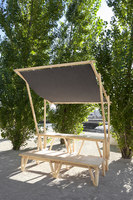
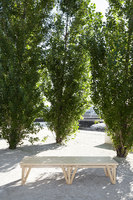
'Unit' by Nosigner for 'AWA'
The Japanese Designer Nosigner started a new collaboration with the Tokushima Wood & Bamboo Industrial Cooperative Society Confederation and founded the new wood furniture brand ‘AWA’. Their new collection will be presented at this year’s Designtide in Tokyo.

'Unit' by Nosigner
“Tokushima was once called the country of Awa, the tradition of wood furniture was initiated by ship builders. Thus, AWA decided to go back to its Tokushima woodworking roots to form this new and yet traditional project to bring Japan’s wood working culture into the future.”

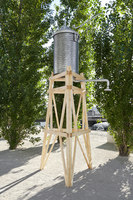
'Cartesia' by Nosigner

'Cartesia' by Nosigner

'Cartesia' by Nosigner
more Nosigner products @ Architonic
‘Kanpyo Udon’ – packaging by Nosigner
Thu 2.7.
Posted by NoéMie Schwaller on 02.07.2009 - Tagged as: Austria, bench, M&G, wardrobe
Wardrobe Twinni by M&G
M&G from Austria recently launched the wardrobe Twinni. The cheerful design was created by Heinz Glatzl and Joachim Mayr, founders of M&G Interiors. The unadorned framework implements the shape, but Twinni is more than that: it is a seating bench with storage capacity made out of matt-lacquered MDF (medium density fiberboard). We will surely soon see more innovative ideas for wardrobes from M&G.

Design by Heinz Glatzl and Joachim Mayr
more products from M&G @ Architonic
'Filament Wound Bench' by Moorhead & Moorhead
While Granger Moorhead studied architecture at Yale University his brother Robert made his Bachelor of Fine Arts and Bachelor of Industrial Design at the Rhode Island School of Design. After a couple of years work experience they formed their own studio Morrhead & Moorhead in New York. In fact many of their products somehow demonstrate the different educational background of the brothers.
One of my favourites is the ‘Filament Wound Bench’ which consists of an extremely light construction made of carbon fibre.

Production of the 'Filament Wound Bench'
“The wrapping pattern for Filament Wound Bench was developed to allow a single band of filaments to be wrapped continuously around a reusable mold. The pattern can be easily adjusted using winding software, allowing a number of unique pieces to be generated off of a single mold.”

'Sidearm Chair' by Moorhead & Moorhead
“‘Sidearm Chair’ was designed to enable a young company, with modest resources, to execute economic production runs. CNC technology efficiently converts readily available raw materials, with minimal waste and tooling. Outsourced components are shipped flat, minimizing shipping costs and warehouse space.”

'Felt Stool' by Moorhead & Moorhead
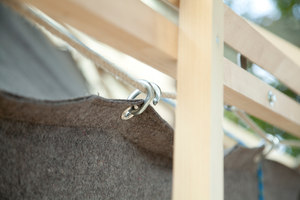
The felt stool is an investigation in structural folding.
“Felt Stool is comprised primarily of a sheet of felt which has been folded and riveted to create structural volume and upholstery simultaneously.
In the spirit of origami, a series of folding patterns were developed, each starting with a single sheet of industrial felt. As the exploration evolved, the pattern was refined to efficiently use material and create a comfortable saddle-shaped seat.”
to the Moorhead & Moorhead website

'Rocket' flooring by Skulpturfabriken
The Swedish manufacturer Skulpturfabriken, located on the beautiful island of Gotland, is specialize in the design and fabrication of concrete products for both interior and exterior environments. The whole collection of the monolithic and sculptural products is designed by the Stina Lindholm.
The materials she uses include concrete, sometimes in combination with other natural material. These are made into benches, planters, counter tops, tabletops, and other applications.

'Kobbe' by Skulpturfabriken

'Juno' bench by Skulpturfabriken
more Skulpturfabriken products @ Architonic
'ladder no.1' by Casimir
CasimirMeubelen is a Belgian manufacturer founded in 1995 by Casimir, one of the most important Belgian contemporary designers. The whole collection is designed by him, which gives the company a very strong profile and recognition value.
Almost all of the pieces are made of natural materials such as solid wood and leather and stand out by their simplicity, shapes and craftsmanship.

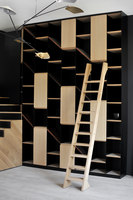
'ladder no.1' by Casimir
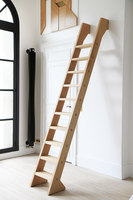
‘Ledder no1′ combines the function of a portable set of steps with the function of a storage unit. The ladder’s rungs have been transformed into book cases and shelves of unequal sizes. By placing these storage units on the back of the ladder, the ladder leans against the wall with even greater stability.’

'Poutrel' by Casimir
‘The beam (in Flemish dialect called ‘poutrel’) is one of the principal elements in construction with a very clear function: to support. This ‘Poutrel’ is withdrawn from its usual context, surrounded by other constructional members, and reduced to the I-form.
However recognisable by its form, the use of solid wood gives ‘Poutrel’ an entirely different look. At the same time the wooden Poutrel’s function becomes ambiguous. ‘Poutrel’ still supports, but is no longer compulsory within a construction and can therefore be used in different ways: as a bench, a table, a TV bench, …’

'Zak no.2' by Casimir
‘The series ‘Zak’ are based on an ordinary object in its original function (carrying / storing) and form, but made of an exceptional material (leather). One of the most archetypal and useful utensils of our times, the carrier bag (in Flemish dialect called ‘zak’), is reformed to last as durable furniture.
‘The bag’s form has been maintained. Just like the plastic version, each bag in ‘Zak no.2′ slightly deviates from the perfect model. The quality of the materials and the property of leather to age gracefully, incite one to use this furniture. The soft leather furthermore causes the bags to take the form of their contents. The leather bags are hooked into a stackable oak frame and can be filled, transported, filed, …’
to the CasimirMeubelen website
'Ljubljana' cahir by Movisi
The German manufacturer Movisi recently presented this modular system designed by the Slovenian designers Asobi.
The lightweight system allows different types of seating to be built. Short lounge chair or long public bench – two different Ljubljana modules (with backrest and without backrest) offer endless design possibilities.
The system features slices made from ARPRO® (Expanded Polypropylene), that are connected with a thread rod to create seating isles for different interior settings. An outdoor version with UV treatment is available (on request).

'Ljubljana' bench by Movisi
The ‘Ljublijana’ chair is quick to construct and quick to change; unique and diverse in its capabilities to modify its design as many times as the end user chooses to. The compositions can be up to 6m long.

Construction
more Movisi products @ Architonic
'Ivy' by Paola Navone
The ‘Ivy’ collection designed by Paola Navone for Emu is inspired by the ancient “topiary” art, the trimming of trees ad shrubs in order to give them ornamental shapes. This art derived from the attempt to “model” nature, as in the words of Shirley Hibberd, the person responsible for the revival of topiary in England in the late 1800s: “It may be true, as I believe it is, that the natural form of a tree is the most beautiful possible for that tree, but it may happen that we do not want the most beautiful form, but one of our own designing, and expressive of our ingenuity.”

'Ivy' by Paola Navone
Finding inspiration in this art, Paola Navone has designed sculpture-furniture created for living in and beautifying outdoor areas, structures created using the natural material par excellence — metal — bent to the will of the human mind.
The meeting between the designer and Emu made it possible to mold an apparently “hard” material such as metal, obtaining three-dimensional shapes so light that they give the impression that they could float in the air.

'Ivy' by Paola Navone
The structures of sofas, armchairs and table, empty inside, incorporate nature and become an integral part of it thanks to their noninvasive character, which harmonizes with the surrounding landscape.
They are objects created to be left outdoors nonchalantly, furniture that will allow itself to be “eaten up” by ivy like statues, and those who sit on it will fully experience the feeling of being immersed in nature.
more EMU products @ Architonic

'FIDU Bench' by Oskar Zieta
With his charming ‘Plopp’ stool the Polish architect presented the innovative technology of inflatable metal structures to the design scene.
“In future we want above all to design objects which are inflated but don’t look as if they have been inflated” Oskar Zieta said. With the very precise and smooth looking ‘FIDU Bench’ he came one step closer to this aim.
You can see Oskar Zieta´s work at this year´s DMY Festival in Berlin at the DMY Allstars exhibition.

'FIDU Bench' by Oskar Zieta
to the Oskar Zieta interview @ Architonic
to the DMY Berlin website