September 2010
M T W T F S S
« Aug    
 12345
6789101112
13141516171819
20212223242526
27282930  

Posts tagged as 'apartment building'

tecARCHITECTURE HQ by tecARCHITECTURE, photo by Peter Allgaier, tec Architecture

The Switzerland and US based architecture and design practice tecARCHITECTURE (CH) and tecDESIGN (US) recently unveiled their new Headquarter in the city of Ermatingen on Lake Constance. Tec’s new offices are part of the building as well as two rental apartment units and a house for tec coo Heiko Ostmann and his family.

(more…)

ERA3 - Eraclito Housing, photo by Gabriele Pranzo-Zaccaria, Chiara Pranzo-Zaccaria

Where an old industrial building used to be, in the northern outskirts of their hometown, the Milano based practice LPzR Architetti realised this apartment building with 25 residential units.

ERA3 - Eraclito Housing, photo by Gabriele Pranzo-Zaccaria, Chiara Pranzo-Zaccaria

“The new building completes the urban landscape by connecting the façades and covering the blind walls of the adjacent constructions. According to the height range of surrounding buildings, ERA 3 has from five up to seven storeys. Basement and mezzanine host parking lots.

The building is a manifesto of complexity in contemporary architecture. The volumetric composition shows a sequence of addictions and subtractions. A wide range of materials like plaster, zinc, wood, concrete, steel, glass, stones, are combined together to underline the arrangement of volumes and surfaces.

The construction of the volume is based on the aggregation of modules of 45 sq m (GFA), which is considered as the minimum surface of a living unit. Bigger apartments are made of two modules. Outdoor living spaces play an important role in design criteria.”

ERA3 - Eraclito Housing, photo by Gabriele Pranzo-Zaccaria, Chiara Pranzo-Zaccaria

ERA3 - Eraclito Housing, photo by Gabriele Pranzo-Zaccaria, Chiara Pranzo-Zaccaria

ERA3 - Eraclito Housing, photo by Gabriele Pranzo-Zaccaria, Chiara Pranzo-Zaccaria

ERA3 - Eraclito Housing, photo by Gabriele Pranzo-Zaccaria, Chiara Pranzo-Zaccaria

to the LPzR Architetti profile @ Architonic

'HipHouse Zwolle', photo by Ulrich Schwarz, Berlin

New Poverty = New Richness: With the realisation of this apartment building in Zwolle / Netherlands the Rotterdam based architectural practice Atelier Kempe Thill created 64 new highly comfortable social housing units and offered an alternative to the typical deck-access housing of the 1970s.
'HipHouse Zwolle', photo by Ulrich Schwarz, Berlin

“At the dawn of a new era of neo-liberalism in Europe, social housing is once again regarded with increasing indifference. The implicit assumption is that apartments for the lower social classes ought to be small, cramped, dark, badly built and ugly.
Architecture in the sense of a building art hardly plays a role here, for marketing and spatial qualities are regarded as unimportant and superfluous.
Furthermore, social housing developments are facing great financial pressures due to a tightening of environmental laws, which entails a considerable increase in costs for technical equipment and building components, and negatively affects design opportunities.
International star-architects barely show any interest in the topic. Accordingly, very few alternatives (to standard solutions) are being produced which, by becoming showcases, could act as catalysts to break out of the recent stasis.
The Hiphouse project in Zwolle presented Atelier Kempe Thill with a welcome opportunity to fundamentally question the assignment ‘social housing’. Largely due to the client’s ambition and the active support of urban planners, a prototypical project could be realized without exceeding a typical Dutch standard budget for comparable projects. A radical minimization of architectural means and a visible assertion of the processes and technologies of the building process helped to realize a maximum of living quality.”

'HipHouse Zwolle', photo by Ulrich Schwarz, Berlin

“The deck-access typology is the most common form of multi-story social housing in the Netherlands, because a large number of apartments can be connected to a limited number of stairwells. Despite the social stigma this typology has come to represent, it remains an almost inevitable solution. Due to its extreme cost-efficiency it is still being employed today in large numbers. The very compact building typology realized through the central circulation in Zwolle offers an economic and competitive alternative.
The building block, measuring 23m x 32m and providing 8 units per floor, has a very limited facade surface in relation to its floor area; this favourably affects building costs and enables the high quality detailing of the facade. The housing units are organized around a central core containing a double stair and an elevator. The plan layout allocates the larger apartments to the spatially interesting corners, thus creating apartments with double orientation.
The smaller studio apartments either face east or west, guaranteeing optimum sunlight for all apartments. To compensate for its volumetric compactness, the building’s surface is consistently glazed. Anodized aluminium profiles hold the high quality solar-protection glazing to form the facade. Depending on the viewer’s position the building appears to be covered by a transparent skin or a reflective surface; furthermore, sliding doors provide generously dimensioned facade openings.
As a whole, a very delicate visual balance is achieved. The functional grid of the windows and the underlying construction form a rigid architectural order, which is counterbalanced by a spontaneous collage of colourful apartment interiors. In a display of the complexities of city life a vital and optimistic image emerges, striking up intensive communication with the neighbourhood. This image is collective as well as individual, for it is – consciously or unconsciously – formed with the active participation of every inhabitant. The ‘building in use’ therefore essentially becomes the facade.”

'HipHouse Zwolle', photo by Ulrich Schwarz, Berlin

'HipHouse Zwolle', photo by Ulrich Schwarz, Berlin

'HipHouse Zwolle', photo by Ulrich Schwarz, Berlin

more information about the project @ Architonic

to the Atelier Kempe Thill profile @ Architonic

'The Sil(o)houette' by C.F. Møller Architects

The Danish architectural practice C.F. Møller recently unveilded this new apartment building – a conversion of an old disused silo complex into a ‘rural high-rise’, with 21 high-quality residences composed as individual and unique ‘stacked villas’.

'The Sil(o)houette' by C.F. Møller Architects

“The ‘stacked villas’ are an alternative to standard apartments or to detached suburban sprawl, and are a mix of single storey flats and maisonettes, meaning that even the lower levels fully get to enjoy the views, and that no two flats are the same.

The actual silo contains staircases and lifts, and provides the base of a common roof terrace. Around the tower, the apartments are built up upon a steel structure in eye-catching forms which protrude out into the light and the landscape – a bit like Lego bricks.

This unusual structure with its protrusions and displacements provides all of the apartments with generous outdoor spaces, and views of Aarhus Bay and the city itself. Similarly, every apartment enjoys sunlight in the morning, mid-day and evening, whether placed to the north or south of the silo structure.”

'The Sil(o)houette' by C.F. Møller Architects

The interlaced annexes create intimate living spaces with a maximum of direct natural light.

'The Sil(o)houette' by C.F. Møller Architects

'The Sil(o)houette' by C.F. Møller Architects

Silo before conversion

Location: Løgten, Denmark
Client: Løgten Midt A/S
Architect: C. F. Møller Architects in collaboration with Christian Carlsen Arkitektfirma
Landscape Architect: C. F. Møller Architects
Engineer: Niras
Size: 3000 m2 (silo conversion housing), 1500 m2 (mixed-use urban centre)
Year: 2004-2010


to the C.F. Møller Architects profile @ Architonic

seen @ Dagensdesign

'NE apartment', photo by Hiroyasu Sakaguchi

This serpentine apartment builduing in the center of Tokyo was designed with the collaboration of three Tokyo based architectural practices: Nakae Architects, Akiyoshi Takagi Architects and Ohno Japan.

'NE apartment', photo by Hiroyasu Sakaguchi

“This 8-unit rental apartment house complex was designed to house motorcycle enthusiasts, with a built-in garage included in every unit.
The building is located on a flag-shaped plot near the apex of a triangular block, with a certain degree of open space toward the main road to the south.
The c-shaped design was a practical decision to allow the residents to access their apartments through a common alley that leads right to the center of the complex. The wall on the entrance side was curved to provide maximum space on the outside, while guaranteeing sufficient volume for each apartment unit and wall length to fit 8 entrance doors. The resulting little square avoids giving the impression of a narrow and dark dead end, and allows the residents to rotate their bikes easily.
The walls separating each apartment unit were disposed in a radial pattern, each with a gentle curve that leads them to meet the external wall at a right angle. By connecting the angles of each room, the curved walls contribute to give the impression of a more spacious environment. The entire structure is designed as an extension of the road, smoothly following the movement of its residents as they drive through the alley, enter the central square, park their motorcycle in the garage and move upstairs to their living quarters.”

'NE apartment', photo by Hiroyasu Sakaguchi

“The building is a reinforced concrete structure composed of seven walls and a slab. The main characteristic of the structure lies in the fact that the reinforced walls, composed of an in-plane rigid frame of columns and beams, were disposed in a radial pattern. The walls rely on the transfer of horizontal force from the slabs instead of using perpendicular beams. They are in fact vertical cantilevers fixed in the foundation of the building. Although the centrally-oriented radial displacement is vulnerable to rotational forces, the changing angles of each wall reinforce the structure’s resistance.
Because the structure of the building relies on the seven interior walls, the exterior wall was handled using a dry construction method. This allowed us to continue studying the emplacement and size of the wall openings in accordance with the uneven surroundings until the very last moment of the construction process. The functions of each wall are also enhanced by a clear division of their roles: structure and sound insulation for the interior walls, openings and thermal insulation for the exterior walls. Despite their curve, the interior walls always meet the outside wall at right angles, preventing the presence of sharp corners and thus improving livability.
On the entrance side, each floor is fitted with a continuous strip of curved windows, with a comparatively wider opening on the second level. The orientation of each room was set to avoid a direct view of the opposite apartment. Combined with a double-paned window, this setting provides a peculiar feeling of privacy.”

'NE apartment', photo by Hiroyasu Sakaguchi

'NE apartment', photo by Hiroyasu Sakaguchi

'NE apartment', photo by Hiroyasu Sakaguchi

Design team:
Yuji Nakae / NAKAE ARCHITECTS
Akiyoshi Takagi / Akiyoshi Takagi Architects
Hirofumi Ohno / Ohno JAPAN
Project partners:
General Constructor: FUZZY, CO., LTD.

Site Area: 201.89m2
Building Area: 96.34m2
Total Floor Area: 289.02m2
Structure: Reinforced Concrete and Steel, 3 stories
Maximum Height: 8050mm
Design Period: Dec.2006 – May.2007
Construction Period: Jun.2007 – Dec.2007


to the Nakae Architects profile @ Architonic

'Bumps' by SAKO Architects

'Bumps' by SAKO Architects

The Japanese SAKO Architects realised this Housing complex in south-west of Beijing. It consists of four residential building, as well as one commercial building. ‘Bumps’ is one of this months WAN Awards entry in the Residential category.

'Bumps' by SAKO Architects

'Bumps' by SAKO Architects

'Bumps' by SAKO Architects

'Bumps' by SAKO Architects

more information at Word  Architecture News


to the SAKO Architects website

 Paswerk with 119 homes in Haarlem / Netherlands by Architectuurstudio HH

Paswerk with 119 homes in Haarlem / Netherlands by Architectuurstudio HH, photo by

The Amsterdam-based Architectuurstudio HH realised this energy-efficient residential neighbourhood in Haarlem in 2007.

Plaswerk by Arcchitecturrstudio HH

Paswerk by Architecturrstudio HH, photo by Herman van Doorn

Here is what the architects explain:

“In Haarlem there is a green belt between the Schalkwijk area and the River Spaarne, where a number of small-scale businesses existed for many years. Here we have developed, together with Blauwhoed Eurowoningen, a residential neighbourhood with 119 homes in a way that preserves the area’s landscape qualities. The housing layout is extremely flexible with a number of basic options that can be extended in various ways. High-quality architecture, external environment, sustainable building, flexibility and energy-conscious/energy-efficient construction were the key points of departure for this project. The houses are highly energy-efficient and have low-temperature underfloor heating combined with a heat recovery system with solar water heater and heat pump. ‘Mossedum’ roofs reduce the cooling load and can absorb a significant amount of rainwater.”

Patio, Paswerk by Architectuurstudio HH, photo by Katja Effting

Patio, Paswerk by Architectuurstudio HH, photo by Katja Effting

Parkland

“Paswerk nestles in a medieval peat excavation landscape with narrow strips of land reflected in the irregular rhythm of the east-west orientated ditches. This ditch pattern was interrupted at Paswerk. 

The development of a new residential park on the Paswerk site is an opportunity to enhance the character of the peat landscape between the Engelandpark and the River Spaarne by reconnecting existing ditch fragments and laying ponds in a way that hardly affects the topography and preserves the existing stands of old trees. Opening up the residential park into three strips allowed residential building to be interwoven with the peat landscape. A trio of new, lengthened lakes gives identity to the three residential clusters and provides a logical transition to the surrounding area, as well as a storage place for the rainwater from the roofs. The shoreline is occasionally broken to accommodate a stand of old trees. And the houses are positioned in such a way that the existing old trees supplemented with new ones can stay where they are between the houses, or new ones be planted where necessary.

Completely new parkland is created thanks to a compact building typology. To preserve the parkland identity there is virtually no ground level parking in the plan. All houses have a parking space in one of the buildings’ underground garages, which also contain parking space for visitors.”

Plaswerk by Architectuurstudio HH, photo by Marijke Mooy

Paswerk by Architectuurstudio HH, photo by Marijke Mooy

Differentiated housing 

“The Paswerk plan includes 119 houses, 78 of which are patio houses and 41 canal houses and town houses. The single-storey patio houses have roof gardens and terraces on top.”


Flexibility

“The patio houses consist of two ‘naves’: one with bedrooms, bathroom, storage space, entrance and patio, and one that is not subdivided containing the living room/kitchen. The great width of the house (8.10 m) allows the brief to be tailored to individual requirements, whereby one can choose between living on the street side or around the patio. Or one can opt to live up on the roof garden and roof terrace floor, with the possibility of a void to the ground floor.”


Facing the sun

“All the houses face south. The town houses have large façades and conservatories on the south side. The patio houses have their living area on the north side of the patio, creating an outdoor space on the south side. The houses are highly energy-efficient.”


Paswerk: green neighbourhood

“The houses are positioned across the site in a way that allows the existing valuable trees to remain in place between the houses or new ones to be planted. Public recreational land consists primarily of green strips planted with trees on the banks of the broad water features. By placing the parking facilities in the buildings (large garages encapsulated in the town houses) the neighbourhood looks car-free (little traffic) and there are plenty of safe places for children to play near and in between the houses.”

Paswerk by Architectuurstudio HH, photo by Katja Effting

Paswerk by Architectuurstudio HH, photo by Katja Effting

Paswerk by Architectuurstudio HH, photo by Marijke Mooy

Paswerk by Architectuurstudio HH, photo by Marijke Mooy

to the Architectuurstudio HH website

Stadthaus Zurlindenstrasse, Zurich

Stadthaus Zurlindenstrasse, Zurich

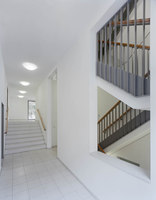
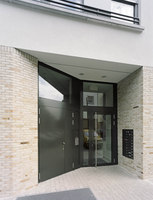
The Zurich based Architects huggen berger fries designed this apartment building in a quiet quarter surrounding Idaplatz which was created towards the end of the 19th Century.

Stadthaus Zurlindenstrasse

Stadthaus Zurlindenstrasse

The residential building closes the last gap in the quarter.

The building consists of an existing courtyard building and a new building facing the street. The apartments on the four lower floors cover both the new and the older sections. The small units of the old building accommodate the bedrooms, while the new section contains the living rooms, the naturally lit staircase and the large entrance hall. The two upper floors also contain a duplex apartment. 

Stadthaus Zurlindenstrasse

Stadthaus Zurlindenstrasse

The glazed ceramic cladding’s profile and light reflections accentuate the tower-like volumetric upward development. The form and colour of the ceramic plates were specially developed for the building. The facade is based on a back-ventilated Sto-Verotec system. The solid window linings highlight the monolithic character and bind the building into the periodic style of the rest of the street’s architecture. The ornamental railings enclose the structure and create a connection with the sky.

Stadthaus Zurlindenstrasse

Stadthaus Zurlindenstrasse

Stadthaus Zurlindenstrasse

Stadthaus Zurlindenstrasse

to the huggen berger fries website

'Lanserhofwiese' in Salzburg / Austria by Wimmer Zaic

'Lanserhofwiese' in Salzburg / Austria by Wimmer Zaic

Housing shortage is a major urban problem, especially for alpine countries. In 2005 the city of Salzburg developed an overall housing concept which included the creation of at least 300 apartments per year. Apart from new site development on the outskirts, urban densification of existing residential areas was included.

One successful example is the project ‚Lanserhofwiese’ by the Austrian architects Wimmer Zaic Architects. The 74 000 sqm site is covered with buildings of the 1970s which the Salzburg-based architects completed with four extended apartment blocks and one solitaire.

The solitaire

The solitaire

Here is what the architects say:

The buildings along Moosstraße are rhythmical, and quiet, and linear. By their structure they do not form a barrier against Moos­straße but are in an interaction with street and surrounding buildings. There are insights and vistas. Between the buildings, which stand in varying distances to each other, there are free spaces of ways. The buildings have three storeys and in the fourth storey there are some punctual cubes.

The buildings along Moosstraße are painted with the basic colours “red/yellow/blue”and the mixed colour “green”. On each building these colours are applied in varying nuances so that a differentiated and lively aspect is created.

Walers along the street

Extended apartment blocks along the street

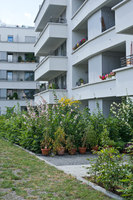
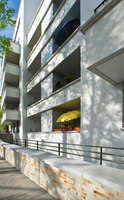
The buildings are oriented towards west, the sides of the buil­dings towards Moosstraße have covered walks (outdoor corridors) which provide noise protection. The apartments have loggias facing west which are formed by retractions into the skins of the buildings. The parapets have parapet walls so that the plaster facing is continued. Through the loggias the deep sun shines into the buildings but the high sun is shut out. This concept also contributes to the aspect of saving energy: the windows to the west are large, which enables the natural use of solar energy and the reduction of artificial energy.

In the centre of the building site a solitaire rises and towers the other buildings along Moosstraße in its third dimension. This “solitaire” is meant to decisively enlarge the pattern of the whole site. The large space inside allows a building of that size, a point of orientation in an otherwise free view on the surroundings.

The zone of the ground floors is kept free and transparent. Thereby a hovering and airy picture of the tower is achieved. Only the vertical element – the glass lift tower – is to be seen.

View from the solitaire

View from the solitaire

The succinctness of the tower is – apart from its dimensions – achieved by its quiet plaster facing, which has only punctual windows. Only in the uppermost storey there is a round band of balconies with a round glass parapet. On the other hand there are cubes protruding from the tower which are also marked by their colouring. The cubes are covered by large aluminum plates which give the tower a somewhat strange appearance. Onto the plates pictures of the “Sahara”  are printed, a sa­tellite photograph of Geospace Ltd. They can also be found on the retreating walls of the “solitaire”.


Project team: Robert Wimmer, Michael Zaic, Dagmar Braitenthaller, Daniel Drücker, Manuel Dornstauder, Thomas Hahn, Martina Lodek, Thomas Kögl, Petra Waldmann, Reinhard Wimmer

Start of planning process: February 2000

Start of construction: May 2004                    

Date of completion: October 2007

Construction costs: about 10 Mio. €

Land area: about 74.000 square meters

Net floor area: about 5.500 square meters

Gross floor area: about 12.000 square meters

Cubic contents: about 33.0000 cubic meters


to the Wimmer Zaic website

Songzhuang Artist Residence by DnA

Songzhuang Artist Residence by DnA, Photo by Iwan Baan

This is the Songzhuang Artists’ Residence designed by DnA in Beijing, China. Located right next to east sixth ring road of Beijing city, Songzhuang Artist Village is undergoing a dramatic expansion of artist population and increasing demand of artist’s working and living space, a 20-units artist residence facing a fishpond at a former outdoor storage lot is one of the local developments targeting such demand.

Songzhuang Artist Residence by DnA, Photo by Iwan Baan

Songzhuang Artist Residence by DnA, Photo by Iwan Baan

The programmatic requirement of working and living defines the height and geometry of both volumes: 6m height for working and 3m for living; a simple rectangular box for studio and a complex geometry for living indicating bedroom, kitchen and toilet. Living volume is plugged into working volume either on the same level or led by stair to upper level. Corrugated metal as exterior cladding and red brick for horizontal surfaces are used to reflect both industrial and village character.

Songzhuang Artist Residence by DnA, Photo by Iwan Baan

Songzhuang Artist Residence by DnA, Photo by Iwan Baan

These 20 units are regarded as containers stacking up on this former industrial outdoor storage lot, creating an expressive configuration and spatial quality. The interplay of volume and void, light and shadow allows artists and visitors to constantly explore and experiment the outdoor community space, which could be the extension of art production and presentation as well as linking these 20 units as 20 individual showrooms on open studio days.

In other words, this complex becomes an alternative museum for living art creation and exhibitions.

Photo by Iwan Baan

Photo by Iwan Baan

via Dezona


to the Iwan Baan website


to the DnA website

The Independent Source for
Products, Materials and Concepts Architonic | architecture and design
Fascinating World of Design for
Modern Kids Kidsmodern - Fascinating World of Design for Modern Kids
Broadcasting Architecture Worldwide Broadcasting Architecture Worldwide
International Architecture News International Architecture News
Online Design Magazine Online Design Magazine