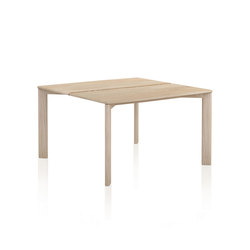
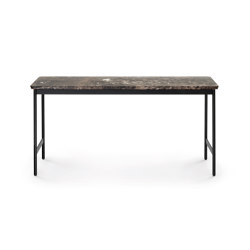
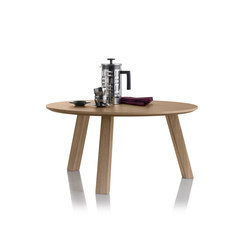
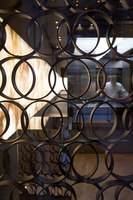
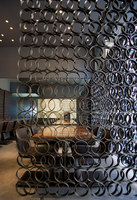
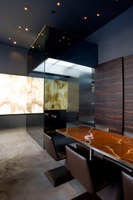
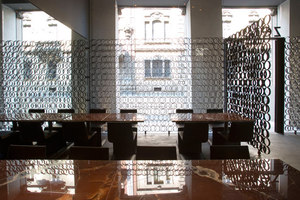
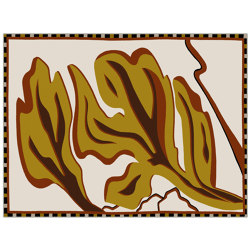
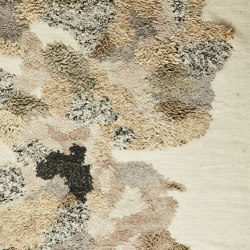
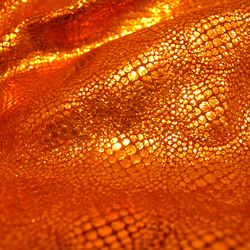
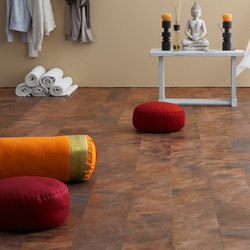
'Macrosterias' by Patricia Urquiola for Budri
During this year’s Salone del Mobile in Milan the Verona based fair for stone design and technology marmomacc presented itself at Triennale. The exhibition “Hybrid and Flexible” set up by Cibic Workshop showcased some of the most remarkable works from Marmomacc Meets Design 2009 by internationally famous designers and marble companies.

'Macrosterias' by Patricia Urquiola for Budri
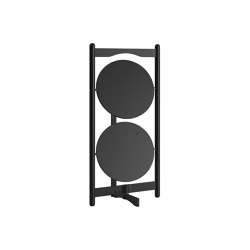
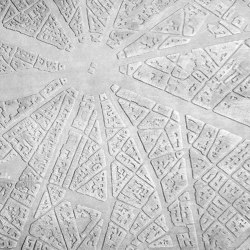
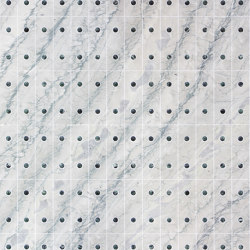
‘Macrosterias’ by Patricia Urquiola for Budri is an installation which represents the metamorphic use of marbles and stones of different origins – a female essence in chemical composition and colours.
The project arose from the observation of vegetal micro-organisms – micrasterias – whose forms mixed with graphic symbols create a new digital-biological entity.

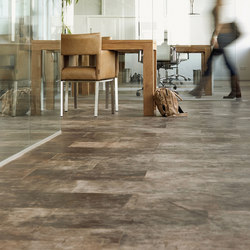
'La Idea Construida' by Alberto Campo Baeza for Piba Marmi

'La Idea Construida' by Alberto Campo Baeza for Piba Marmi

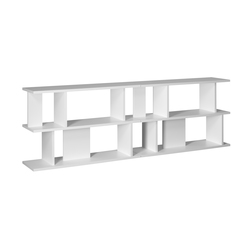
James Irvine for Marsotto Edizioni
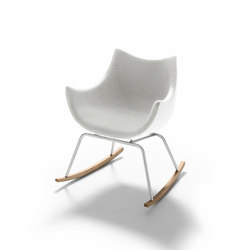
Marsotto Edizioni is a growing collection which started with designs of James Irvine in 2008. This year the collection was enlarged with creations by Konstantin Grcic, Naoto Fukasawa and others.

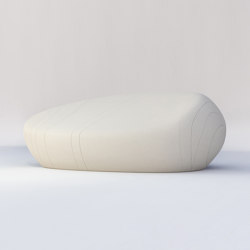
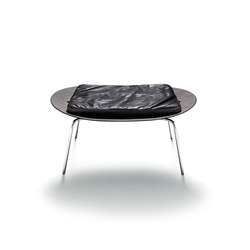
Low table by James Irvine for Marsotto Edizioni

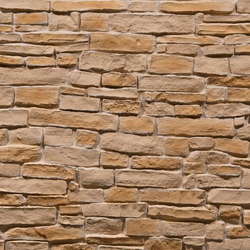
Michele De Lucchi for MGM Furnari
more Michele De Lucchi products @ Architonic
more James Irvine products @ Architonic
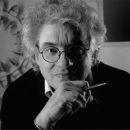
to the Alberto Campo Baeza profile @ Architonic
more Patricia Urquiola products @ Architonic
Olnick Spanu House by Estudio Arquitectura Campo Baeza
This single family house, situated on an exclusive site close to the Hudson River, is one of the latest projects of the Madrid based Estudio Arquitectura Campo Baeza.

Olnick Spanu House by Estudio Arquitectura Campo Baeza, photo by Javier Callejas
“A place where twilights are a thousand colors as the water breaks into a thousand reflections. A place where the air is clean and calm, and mild. One could say a place that is very close to heaven.
In this impressive place, we establish a plane, a platform that underlines the landscape before us, seeking to enhance it.
A large long box is thus built, 122 feet long by 54 feet wide by 12 feet high, with sturdy concrete walls that accentuate its relationship to the land. The roof of this box is flat, paved in stone, travertine, so that we may use it.”

Olnick Spanu House by Estudio Arquitectura Campo Baeza, photo by Javier Callejas
“And to protect ourselves from the sun and rain, over the stone plane we raise a light roof 100 feet long by 40 feet wide by 9 feet tall, held by 10 cylindrical steel pillars that are arranged according to a 20 x 20 foot grid. This roof cantilevers 10 feet along all of its sides. And to make this space habitable, we put a glass box under the roof, an enclosure measuring 94 feet long by 25 feet wide. This glass box contains the back row of columns within it and leaves the front columns outside, in order to further accentuate its transparency.”

Olnick Spanu House by Estudio Arquitectura Campo Baeza, photo by Javier Callejas
“This construction on the platform resembles a large table with ten legs. Three areas are created within it, divided by two white boxes that do not reach the ceiling, containing the stairs and service spaces. The central space is the living area, and the dining room has a large white table. On one side, closer to the swimming pool, is the kitchen, and on the other side, in the manner of a pensatorio, the area around the hearth.
And below, inside the cement box, the bedrooms and baths are housed. In its central vestibule, connecting the main entrance and the access to the garden, a gallery has been created where pieces of Arte Povera and other pieces of contemporary Italian art are displayed, in addition to other areas around the house.
In all, once again, the hut over the cave. The tectonic piece on top of the stereotomic piece.”

Olnick Spanu House by Estudio Arquitectura Campo Baeza, photo by Javier Callejas

Olnick Spanu House by Estudio Arquitectura Campo Baeza, photo by Javier Callejas
Clients: Nancy Olnick & Giorgio Spanu
Architect: Alberto Campo Baeza, Estudio Arquitectura Campo Baeza, S.L.
Project Manager: Miguel Garcia-Quismondo, architect
Collaborator: Ignacio Aguirre, architect
Strictural engineer: Michael P. Carr, P.E., Maria Conception Perez Gutierrez, Architect
MEP Engineers: D’Antonio Consulting Engineers
General Consultants; Massimo & Lella Vignelli
Lighting Consultant: Gary Gordon, LLC
Concrete Consultant: Reginald D. Hough, FAIA
Colour Consultant: Donald Kaufman & Taffy Dahl
Glass Consultant: Juan José Pérez Pina Mel Lebo
Location: Garrison, New York (USA)
Area: 900 m2
Timing: 2003 Project
2004 Demolition of old construction
2005 – 2007 Construction
2008 Furnishing
to the Estudio Arquitectura Campo Baeza website
Museo De La Memoria De Andalucia in Granada / Spain by Alberto Campo Baeza
Museo De La Memoria De Andalucia, Photos by Javier Callejas
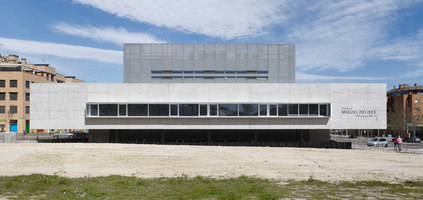
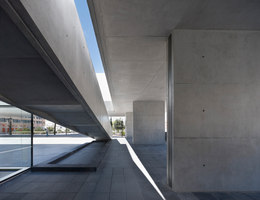
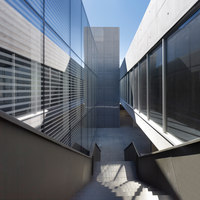
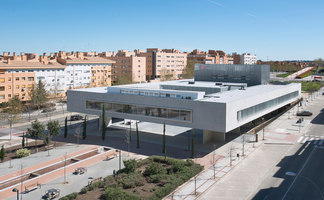
In May this year the Commune of Granada, Spain opened the new Museo De La Memoria De Andalucia, designed by the Spanish architecture practice around Alberto Campo Baeza. The complex consists of a massive vertical building and a lower part with a central patio in ellipsoidal form in which some circular ramps connect the three levels.

The complex consists of two main buildings, Photos by Javier Callejas
What the architects say:
“Our project for the MA (Andalusia’s Museum of Memory) in Granada is a building in the line of the headquarter of the Caja Granada Saving Bank which we completed in 2001. We propose a podium building measuring 60m x 120 m and three stories high, so that its upper floor coincides with that of the lower body of the podim of the main building of the Caja Granada – and also the façade. Everything is arranged around a central patio.
And to a top it all, as if it was a Gate to the City, a strong vertical piece arises, the same height and width as the main building of the Caja Granada. It appears in front of the highway that circles Granada like a screen-façade on which to send messages over large plasma screens that will cover it entirely.”

Inside the tower, Photos by Javier Callejas

Inside the patio, Photos by Javier Callejas

The tower, Photos by Javier Callejas
to the Alberto Campo Baeza website