Posts filed under 'Architecture'

'One+' by Add-A-Room
Lars Frank Nielsen architect and founder of the Danish practice ONEN Design has designed this modular architectural system for the Swedish company Add-A-Room. The houses can be ordered in different modules with specific functions and be composed according to the user’s requirements. They are prefabricated in Sweden in collaboration with mainly Scandinavian companies and with the use of local materials.

'One+' by Add-A-Room

'ONE+' by Add-A-Room

The smallest unit with 15 sqm, 'ONE+' by Add-A-Room

Two units with an outdoor cooking module

Two units, arranged long ways, connected through the outdoor cooking module
to the Add-A-Room website
seen @ Dagens Design

Private House, by ZSK Architects, photo by Zsolt Batár
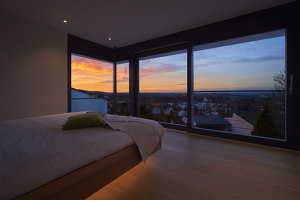
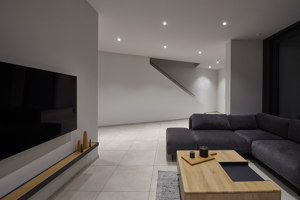
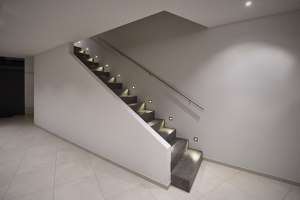
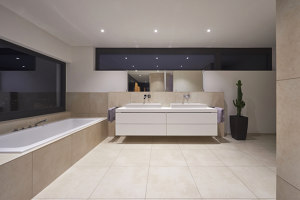
This single family home in a small town southwest of Budapest was realised by the Hungarian practice ZSK Architects. The plain construction is characterised by light natural stone the facade as well as partly the interior is faced with.

Private House, by ZSK Architects, photo by Tamás Bujnovszky

Private House by ZSK Architects, photo by Zsolt Batár

Private House by ZSK Architects, photo by Zsolt Batár

Private House by ZSK Architects, photo by Tamás Bujnovszky

Private House by ZSK Architects, photo by Tamás Bujnovszky
to the ZSK Architects profile @ Architonic

European Nature Reserve Observation Tower by terrain:loenhart&mayr
Recently the Munich based architectural practice terrain:loenhart&mayr unveiled The Murturm Nature Observation Tower at the Mur river in Austria. Following the principles of a double-helix the architects realised a sculptural structure of 27m height which allows scientific monitoring as well as visual access to the river renaturation project. The tower is the inital project of the larger scheme for the MUR NATURE RESERVE, designed by terrain:loenhart&mayr.

European Nature Reserve Observation Tower by terrain:loenhart&mayr

European Nature Reserve Observation Tower by terrain:loenhart&mayr

European Nature Reserve Observation Tower by terrain:loenhart&mayr
to the terrain:loenhart&mayr profile @ Architonic

Earth House, photo by Sung Kwon Kim
This subterranean house was built in honor of the Korean poet Yoon Dong-joo and is designed by Seoul based practice BCHO Architects. It is based on an outer concrete structure, the interior space is devided by rammed earth walls.
“The earth used for the walls is from the site excavation. Even though the viscosity of the existing earth was low, only minimal white cement and lime was used so the earth walls can return to the soil later”, the architects explain.

Earth House, photo by Wooseop Hwang
“The 14m x 17m concrete box is buried in the ground and contains 6, 1-pyeong, rooms and two earth filled courtyards. The ‘small house’ is open to the courtyard which is open to the sky. The one pyeong rooms originated from the size of one kan (6×6 ja; 1 ja = approx. 30cm) which are just large enough for an adult to lie down straight. The house has a small kitchen, a study, two resting rooms, a bathroom with a wooden tub and toilet, and a wash room. The rooms are all adjacent to each other and open directly to the earth filled courtyard. Connecting rooms can be joined to create a bigger room. The house doors are small, entering the house requires making your body into a smaller shape.”

Earth House, photo by Wooseop Hwang
“The lateral pressure from the earth on four sides is resisted by thick concrete retaining wall and a flat roof and base plate. There is also a hidden steel column in the center wall that reinforced the structural plates [...] Four gutters are placed in the corners of the courtyard for drainage. The house uses a geothermal cooling system with a radiant floor heating system under the rammed clay and concrete floor. Off-peak electricity is used at night to heat the small gravel under the floor. A combination of passive cooling and geothermal tubes which are buried in the earth around the buildings keep the temperature cool in summer and warm in winter. A pine tree which was cut down from the site, was sliced into 80mm thick discs and was cast into the concrete walls of the courtyard so as it decays, it will host small plants and new life will arise with time. The wooden canopy protecting the entrance into the small house uses 39mm tensile wires. Recycled lumber was cut into 30mm x 50mm wide pieces and joined with flat steel bar, keeping the material to a minimum. All of the interior furniture and closets are also recycled wood from old Korean gates.”

Earth House, photo by Sung Kwon Kim
“As Yoon’s poetry expresses hope for the future from times of great peril, which he tried to achieve through self-restraint and self-reflection, our hope is that this Earth House would be a house where we can reflect on ‘ourselves’ while living in the present era.”

Earth House, photo by Sung Kwon Kim

Earth House, photo by Wooseop Hwang
Design team:
Architect : Byoungsoo Cho
Project Team : Hongjoon Yang, Woohyun Kang, Taehyun Nam
Project partners:
Rammed Earth Consultant : Keunsik Shin
Contractor : CPLUS International Co. Ltd.
to the BCHO Architects profile @ Architonic

Middle East Technical University Modsimmer Modelling and Simulation Research Center, photo by Yunus Özkazanç – Kerem Yazgan
The Turkish architectural practice YAZGAN Design-Architecture-Construction designed the Modelling and Simulation Research Center for the Middle East Technical University Modsimmer in their hometown Ankara. The building’s composition is based on consecutive functional strips: sun shading steel frame, the eye-catching facade strip made from painted glass in five different colors, the strip of work spaces, storage, counter, shaft, door band, circulation band, atrium and the mirror coated pool base.

Middle East Technical University Modsimmer Modelling and Simulation Research Center, photo by Yunus Özkazanç – Kerem Yazgan
Here is what the architects explain:
“Every element and its components exist in their own constructs within a totality. The building has a double programme; simulation and research center. The circulations of these two different programmes never mix with each other; although they can be related in the future. In order to gain this flexibility, the systematics of layered strips, which resemble Turkish carpet designs, are integrated with the idea of grid in the third dimension, and all constructional elements of this project are adapted to this grid. The whole structural system and the components that make up of the building are located through a 7m x 7m upper grid and 1.4m x 1.4m lower grid. A matrix is formed through that development. The smallest common divisor space of this three dimensional matrix is a room. The elements that make up of the building inside, which are, walls, windows, suspended ceilings, shafts, etc., and the outside, which are, canopies, floor coverings of the plaza, entrance doors, etc. are located by following this grid. The building is formed through this three dimensional matrix and the design of its components and their relations. Rather than following the traditional design approach in which the architect takes part in every design process, the building is the result of a different approach in which the architect is the designer of a flexible system that is achieved through a “design of the design act”.

Middle East Technical University Modsimmer Modelling and Simulation Research Center, photo by Yunus Özkazanç – Kerem Yazgan

Middle East Technical University Modsimmer Modelling and Simulation Research Center, photo by Yunus Özkazanç – Kerem Yazgan

Middle East Technical University Modsimmer Modelling and Simulation Research Center, photo by Yunus Özkazanç – Kerem Yazgan
Design team:
Architects: Kerem – Begüm Yazgan (Yazgan Design Architecture) / Burak Turgutoğlu (SFMM)
Assistant Architect: Buket Demirel – Tuğba Beyaz
Project partners:
Structural Engineering: APCB – Aydın Pelin Can Binzet Engineering
Electrical Engineering: Mustafa Karakaş
Mechanical Engineering: Ünlü Engineering
Landscape Project: Yazgan Design Architect – Begüm Yazgan
Project Manager: Kerem Yazgan
Prime Contractor: Mervecan Construction
to the YAZGAN Design-Architecture-Construction profile @ Architonic

'Skybox House' by Primus Arkitekter, photo by Tina Krogager
North of the island Zealand is traditionally the area where people from Copenhagen have a small and lo-fi summerhouse. The Copenhagen based practice Primus Arkitekter recently realised this modest 75m2 example which is characterised by the typical wooden cladding, large openings and several skylights.

'Skybox House' by Primus Arkitekter, photo by Tina Krogager
But let’s see what the architects have to say:
Layout
With 2 bedrooms it offers a total of 75 m2 of living space. The plot is a partitioning of a larger plot belonging to an old thatched house and is partly enclosed by trees. The two buildings in each end of the plot, is inhabited by two generations, share the garden, and in the layout of the site plan attention has been given to providing both separate and common spaces.
Architectural focus
The main focus has been to add spatiality and experience of light to the relatively small program. The plan sets the bedrooms apart from the large living space and introduces an open hallway. Diagonal views stretch out through the whole building. In working with the section ceiling height is minimized to give contrast to the “sky-boxes” that add spatiality and air.
The large glazed openings incorporate the sky as a 5th façade. Large sliding doors merges the in- and outside

'Skybox House' by Primus Arkitekter, photo by Tina Krogager
Construction
The balloon frame construction sits on the exposed concrete base. 30 x 30 mm oak lists wrap the building. The lists are treated with iron sulfate which darkens and enhances the structure of the wood.
Floor boards are oak as well. Insulation is mineral wool, roof 300 mm, walls 150 mm.
Heating is provided by a heat pump integrated in the wall, reducing heating costs and CO2 emission. The “sky-boxes” ventilate the space trough natural chimney effect. A cast iron stove is for additional heating.

'Skybox House' by Primus Arkitekter, photo by Tina Krogager

'Skybox House' by Primus Arkitekter, photo by Tina Krogager

'Skybox House' by Primus Arkitekter, photo by Tina Krogager
Design team:
Architect: Primus architects, atelier + production
Per Appel (architect maa, partner), David Bülow-Jacobsen (architect maa, partner), Caspar Wissing (student of architecture)
All construction: Primus architects, atelier + production
to the Primus Arkitekter profile @ Architonic